AI Wellness Apps Compared: Which Type of Support Fits You Best?
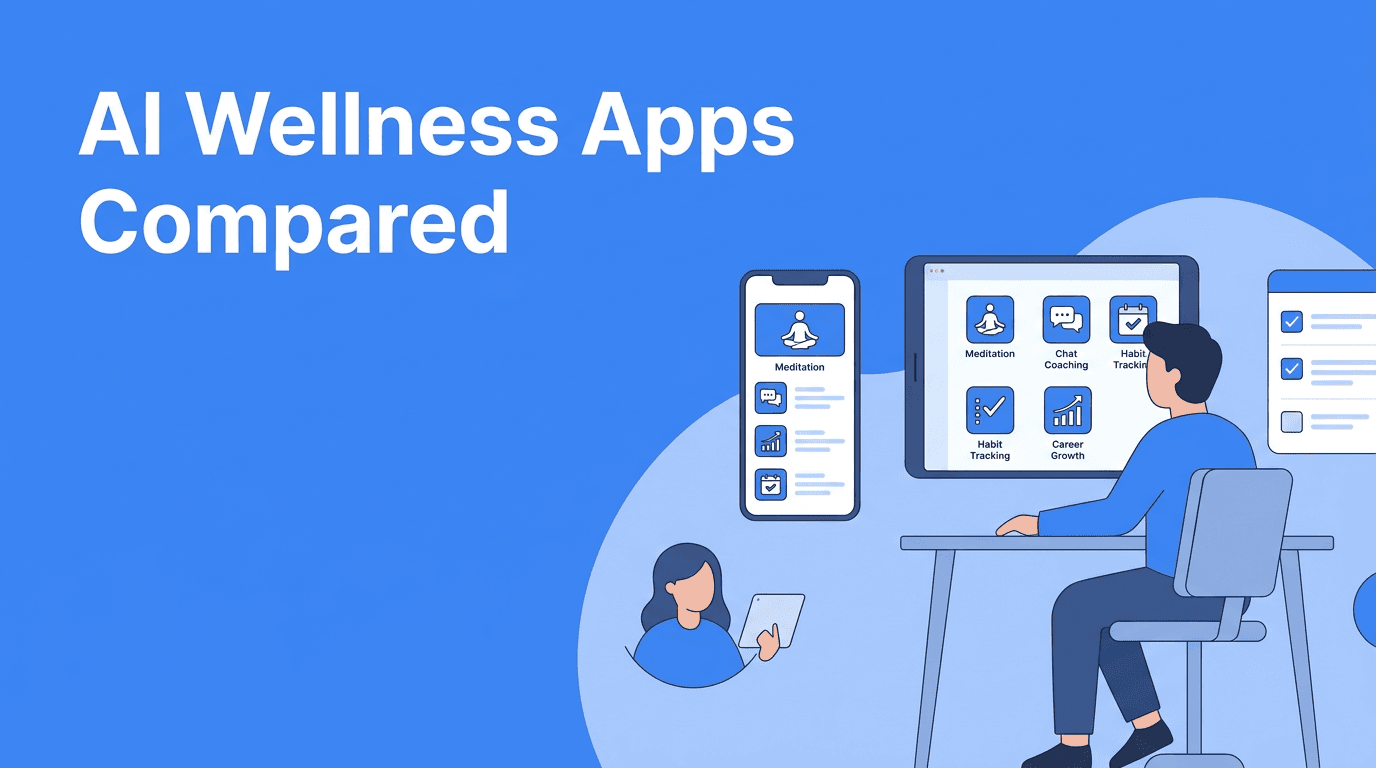
This AI wellness apps compared guide breaks down how structured coaching, meditation, accountability, and chat support differ so you can choose the right app for your goals.

By Haply Team
Haply Editorial Team
Choosing between AI wellness apps can be harder than it looks. Some focus on meditation, some on emotional companionship, some on executive coaching, and some try to be a general chatbot. The real question is not which app is most popular, but which one gives you the kind of support you will actually use consistently.
If you are comparing options before downloading, this guide helps you sort apps by use case, structure, accountability, and cost value. Instead of assuming one app should do everything, it is more useful to understand what each category is designed to do well and where it falls short.
What users often get wrong when comparing AI wellness apps
Many people compare apps as if they all solve the same problem. They do not. A meditation app is not built like a coaching app. A chatbot is not the same as a habit system. An executive coaching platform is not meant for quick daily self-improvement. That is why a fair comparison starts with your goal.
- Choose a meditation-first app if you mainly want calm, sleep support, or guided breathing.
- Choose a coaching-first app if you want action steps, follow-through, and progress over time.
- Choose a companion-style chat app if you want open-ended conversation and emotional interaction.
- Choose a goal system if you need reminders, streaks, and practical tools in one place.
Where Haply fits in the AI wellness apps landscape
Haply is an AI life coaching app for iOS and Android that combines several functions many apps separate. It offers specialized AI coaches across productivity, wellness, career, learning, finance, creativity, and relationships. It also includes a habit tracker, daily reminders, a Today Dashboard, and mini-apps like Focus Timer, Task Planner, Meditation/Breathe, Sleep Stories, Budget Tracker, and Idea Board.
That combination matters because many users do not just need insight. They need a system that turns reflection into repeatable action. Haply stands out by connecting coaching conversations with daily tools, progress tracking, and goal-based onboarding.
The best self-improvement app is not the one with the most features. It is the one that makes the next helpful action feel obvious.
Feature-by-feature comparison: Haply and other app categories
1. Haply vs companion-style AI chat apps
Companion-focused chat apps are usually strongest at free-form conversation and emotional availability. They can feel responsive and engaging, especially if you want to talk through your day. However, they often provide less structure for habits, routines, and measurable progress.
- Companion chat apps: better for open-ended talking and ongoing conversational presence.
- Haply: better for turning conversations into goals, habits, reminders, and daily actions.
- Best for users who want progress: Haply, because support is linked to concrete tools and routines.
- Best for users who want conversational comfort first: companion chat apps may feel more natural.
2. Haply vs meditation-focused apps
Meditation apps are excellent at helping users slow down, breathe, sleep better, and build a mindfulness routine. They are usually content-rich, with guided sessions and calming audio. What they may not offer is adaptive coaching tied to your broader life goals, such as productivity, career planning, or relationship habits.
- Meditation apps: strongest for mindfulness libraries, sleep content, and guided calm sessions.
- Haply: includes wellness tools, but also expands into productivity, career, finance, creativity, and habit change.
- Best for stress relief only: a meditation-focused app may be enough.
- Best for full-life support: Haply offers a broader system.
3. Haply vs executive coaching platforms
Executive coaching platforms can provide premium support, often aimed at professionals and organizations. Their value can be high, but so can the price. They also tend to be less suited to someone who wants daily, self-directed coaching on personal goals without a corporate context.
- Executive coaching platforms: strong for professional development and workplace coaching.
- Haply: more accessible for everyday users who want daily coaching across life areas.
- Best for leadership programs: executive coaching platforms.
- Best for personal growth on your own schedule: Haply.
Pricing logic: what are you actually paying for?
With AI wellness apps, price only makes sense when matched to the product type. A meditation app often charges for content access. A coaching platform may charge for human expertise or premium support. A general chatbot may offer flexibility but not a guided path. Haply's value is in giving users structured coaching plus habit tools plus mini-apps in one subscription, with a 7-day free trial to test fit before committing.
If you usually stack multiple apps, for example one for habits, one for mindfulness, and one for planning, an all-in-one coaching system can be more cost-efficient in practice. If you only need a single narrow use case, a specialized app may still be the better buy.
Honest pros and cons of choosing Haply
- Pros: combines coaching, habit tracking, reminders, and practical mini-apps in one place.
- Pros: specialized AI coaches make support feel more relevant to different life areas.
- Pros: goal-based onboarding helps new users avoid the blank-screen problem.
- Pros: good fit for people who want both reflection and action.
- Cons: users looking only for meditation depth may prefer a dedicated mindfulness app.
- Cons: users wanting human executive coaching may need a premium professional platform.
- Cons: users who mainly want open-ended social chat may prefer a companion-style chatbot.
How to choose the right app for your use case
- Pick Haply if you want an app that connects coaching with habits, planning, and daily follow-through.
- Pick a meditation app if your main goal is relaxation, sleep, and guided mindfulness sessions.
- Pick a companion chatbot if you want frequent conversation without much structure.
- Pick an executive coaching platform if your needs are mainly professional and budget is less of a concern.
Want one app that turns insight into action?
Haply combines specialized AI coaching, habit tracking, and mini-apps for productivity, wellness, career, and more, so you can work on real goals instead of just reading advice.
Try Haply FreeFinal takeaway on AI wellness apps
The right choice depends on whether you want calm content, open conversation, professional coaching, or structured self-improvement. Haply is most compelling for users who want a practical middle ground: coaching that feels personal, but also leads to habits, plans, reminders, and measurable momentum. In a crowded field of AI wellness apps, that combination is what makes it notably different.
Frequently Asked Questions
What are AI wellness apps used for?
AI wellness apps help with areas like stress management, habit building, reflection, productivity, and personal growth. Different apps focus on different outcomes, so the best choice depends on your goal.
Is a coaching app better than a meditation app?
It depends on what you need. Coaching apps are better for action and accountability, while meditation apps are better for mindfulness, relaxation, and sleep support.
How is Haply different from other wellness apps?
Haply combines specialized AI coaches, habit tracking, daily reminders, and mini-apps in one system. That makes it more structured than many chat or content-only wellness apps.
Are AI chatbots good for personal growth?
They can be useful for reflection and conversation, but many lack built-in structure for habits, goals, and progress tracking. That is where a coaching-focused app may be more helpful.