Creative Constraints: How Limits Spark Better Ideas and Everyday Innovation
Creative constraints can sharpen creativity, improve creative thinking, and turn brainstorming into practical innovation. Learn how to use limits to unlock fresh ideas.

By Haply Team
Haply Editorial Team
When people want more originality, they often ask for more time, more freedom, and more options. But creative constraints often do the opposite - they make creativity clearer, faster, and more useful. If you have ever stared at a blank page, overthought a project, or lost momentum during brainstorming, learning to work with smart limits can strengthen creative thinking and lead to real innovation.
Why creative constraints work so well
Too much freedom can overwhelm the mind. When every path feels possible, it becomes harder to choose one and build momentum. Creative constraints reduce decision fatigue. They give your imagination a direction, which often leads to more surprising solutions than unlimited choice does.
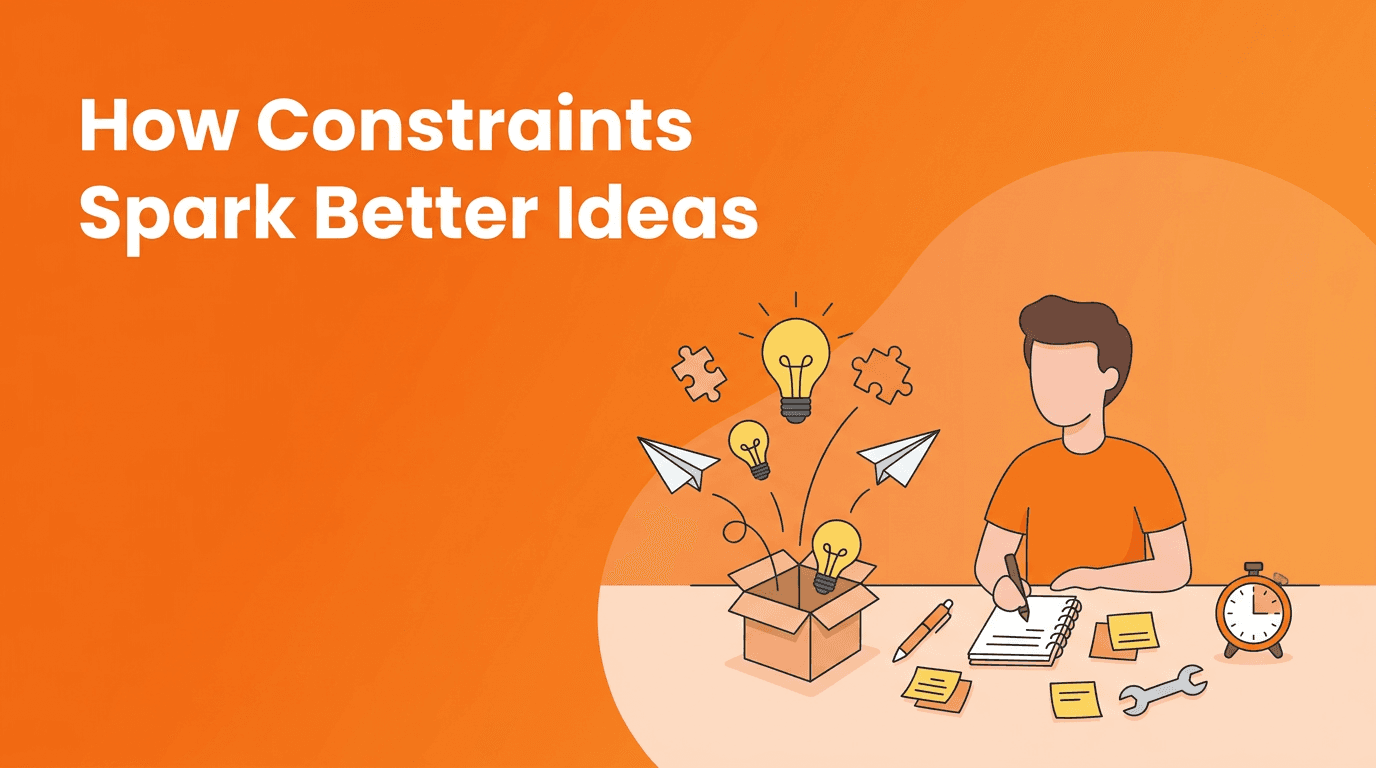
Think about some common examples. A photographer uses only one lens for a day. A writer tells a story in 500 words. A team designs a prototype with a tiny budget. These limits do not kill ideas. They force the brain to ask better questions like, What matters most? What can I simplify? What unusual angle have I ignored?
"Constraints are not the enemy of creativity. They are often the frame that helps the picture appear."
The hidden link between limits and innovation
Many breakthroughs happen because resources are limited, not because they are endless. Innovation often begins when people must adapt. A small budget can inspire a smarter process. A short deadline can reveal the strongest concept. A narrow format can produce a more memorable message.
What constraints actually do to the brain
- They focus attention on what is essential
- They reduce endless comparison and over-editing
- They encourage brainstorming in a specific direction
- They make experiments smaller and easier to start
- They turn abstract goals into concrete creative challenges
This is why creative thinking improves when a challenge is clearly defined. A good constraint is not random punishment. It is a useful boundary that creates energy, urgency, and clarity.
5 types of creative constraints you can use today
1. Time constraints
Set a short window and commit to finishing a rough version before the timer ends. Try 10 minutes for a headline list, 20 minutes for sketching concepts, or 30 minutes for a first draft. Time pressure can quiet perfectionism and activate fast brainstorming.
2. Format constraints
Choose a strict structure. Write in three paragraphs. Design with only circles and lines. Explain your idea in one sentence before expanding it. Format constraints help your imagination work inside a clear frame.
3. Resource constraints
Limit your tools, materials, or budget. Use only what is already on your desk. Create a plan without buying anything new. This approach often produces practical innovation because it rewards adaptability instead of excess.
4. Perspective constraints
Force yourself to see the problem from one unusual point of view. How would a beginner solve it? How would a child describe it? How would you approach it if the goal were joy instead of efficiency? This can refresh stale creative thinking fast.
5. Quantity constraints
Give yourself a fixed output target, such as 15 taglines, 10 sketch ideas, or 7 possible solutions. A quantity rule helps you move beyond your first obvious thought and reach more original territory.
A simple creative constraints routine for work and life
You do not need a full studio or a perfect system to use creative constraints. You just need a repeatable method. Here is a simple routine you can use for writing, problem-solving, content creation, or personal projects.
- Start with one clear challenge. Example: How can I make this idea simpler and more useful?
- Pick one constraint only. Choose time, format, budget, quantity, or perspective
- Set a timer and generate without judging
- Review what surprised you, not just what looked polished
- Keep one insight and test it in a small real-world action
This process builds confidence because it turns creativity into a practice, not a personality trait. Over time, you train yourself to begin faster, think more flexibly, and trust your own imagination.
Build creative momentum with Haply
Want more support turning ideas into action? Haply is an AI life coaching app for iOS and Android with specialized Creativity coaches, chat-based guidance, habit tracking, and tools like the Idea Board to capture and grow your best ideas.
Try Haply FreeHow to avoid using constraints the wrong way
Not every limit is helpful. Some constraints create focus, while others create fear. The goal is to choose boundaries that encourage action, not shutdown.
- Avoid constraints that are so tight they block all experimentation
- Do not stack too many rules at once when starting
- Use constraints to explore, not to punish yourself
- Adjust the boundary if it creates panic instead of momentum
- Remember that a rough result can still contain a brilliant idea
"The goal is not to make creativity harder. The goal is to make starting easier."
Turning creativity into a daily habit
If you want more creativity in everyday life, stop waiting for perfect inspiration. Use smaller containers. Give your mind a challenge. Let limits guide your next step. Creative constraints can help you brainstorm better at work, create more consistently at home, and discover that innovation often begins with less, not more.
If structure helps you follow through, apps like Haply can make the process easier. You can use its Today Dashboard for daily focus, set reminders, track your streaks, and work with Creativity coaches when you want personalized support for your goals.
Frequently Asked Questions
What are creative constraints?
Creative constraints are useful limits, such as time, format, or budget, that help narrow options and guide better idea generation.
How do creative constraints improve creativity?
They reduce overwhelm, focus attention, and push the brain to explore less obvious solutions, which supports stronger creative thinking.
Can brainstorming work better with limits?
Yes. Brainstorming with a clear constraint often produces more relevant and original ideas because the challenge is more defined.
What is an example of a creative constraint?
A simple example is setting a 15-minute timer to generate 10 ideas using only tools you already have available.