
Second-Order Brainstorming: A Smarter Path to Creative Solutions at Work
Second-order brainstorming helps professionals generate better creative solutions by combining problem solving, design thinking, and lateral thinking into one practical process.

By Haply Team
Haply Editorial Team
Most teams stop too early. Second-order brainstorming is a practical way to push past obvious ideas and uncover stronger creative solutions for real business challenges. By extending the first wave of thoughts into consequences, combinations, and alternatives, this method strengthens problem solving, supports innovation, and makes design thinking more useful in fast-moving work.
Why first ideas are rarely your best ideas
In meetings, the first answers often feel productive because they are quick, familiar, and easy to explain. But familiar ideas usually come from familiar assumptions. If you want better creative solutions, you need a method that goes one layer deeper. That is where second-order brainstorming becomes valuable.
- First-order ideas are often obvious, safe, and predictable.
- Second-order ideas examine what happens next, what could combine, and what could be reframed.
- This extra step introduces lateral thinking without making the process feel abstract or overly academic.
How second-order brainstorming improves problem solving
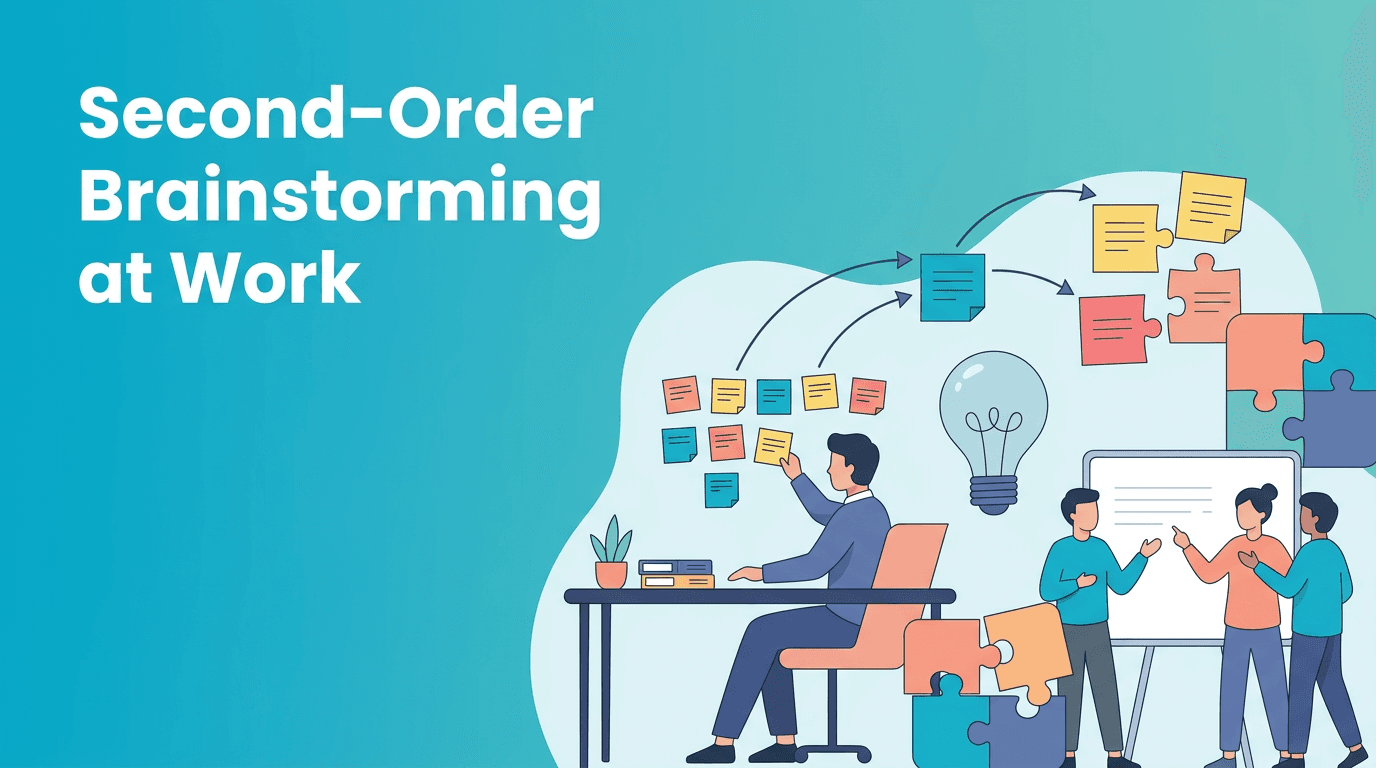
Traditional brainstorming asks, "What ideas do we have?" This method asks, "What does each idea lead to?" That small shift changes the quality of problem solving. Instead of collecting disconnected suggestions, you build idea chains. Each chain reveals risks, hidden opportunities, and unusual angles that basic brainstorming misses.
A simple example
Imagine a startup wants to improve customer onboarding. A first-order idea might be "send a welcome email." A second-order question would be, "What should the email trigger next?" That could lead to a guided checklist, a short demo, a progress reward, or a personalized message based on user goals. Now the team is no longer fixing a touchpoint. They are designing a better system.
"Innovation often appears when you stop asking for more ideas and start asking what each idea makes possible."
The 5-step second-order brainstorming method
1. Define the real challenge
Write the problem in one sentence. Keep it specific and actionable. For example: "How might we reduce friction in the first 7 days of product use?" This keeps the session grounded in design thinking rather than random idea generation.
2. Generate fast first-order ideas
Set a timer for 5 to 10 minutes. List obvious ideas without judging them. Speed matters here because the goal is volume, not brilliance.
3. Expand each idea one level deeper
For every initial idea, ask questions like: What happens next? What else could this connect to? What would the opposite look like? Who else could benefit? These prompts introduce lateral thinking and increase the chance of real innovation.
4. Combine and upgrade
Look for patterns between second-order ideas. Sometimes the best answer is not a single concept but a hybrid. A checklist plus community support plus progress tracking can outperform any one feature alone.
5. Test the strongest concept quickly
Turn the best idea into a low-risk experiment. Sketch the workflow, write a mockup, or pilot the process with a few users. Strong creative solutions become valuable only when tested in the real world.
Where this fits inside design thinking and innovation
Design thinking helps teams empathize, define, ideate, prototype, and test. Second-order brainstorming improves the ideation stage by adding depth. It also supports innovation because it forces teams to explore outcomes, not just outputs. That makes ideas more strategic, not just more interesting.
- Use it after customer interviews to deepen solution concepts.
- Use it in product planning to move beyond feature requests.
- Use it in marketing to find fresher angles for messaging and campaigns.
- Use it in operations to redesign systems, not just patch issues.
A useful habit for busy professionals
If you lead projects, manage a team, or build a business, you do not need endless brainstorming sessions. You need a repeatable thinking habit. Try a 15-minute weekly session where you take one challenge and push three ideas into second-order territory. Over time, this strengthens your instinct for problem solving and helps your team produce more original decisions.
Build your creative practice with Haply
Want help turning scattered ideas into consistent action? Haply offers AI coaching, habit tracking, and tools like the Idea Board to support creativity, focus, and follow-through.
Try Haply FreeFor solo creators and entrepreneurs, Haply can be especially useful between work sessions. Its Creativity coaches, daily reminders, and mini-apps make it easier to capture ideas, reflect on patterns, and stay consistent when inspiration feels uneven.
Common mistakes that weaken creative solutions
- Stopping at the first good idea instead of exploring what it could become.
- Confusing novelty with value. New ideas still need relevance and usefulness.
- Skipping constraints. Clear limits often improve innovation by forcing sharper thinking.
- Avoiding experimentation. Without testing, even promising concepts remain guesses.
Final thought: depth beats volume
More ideas are not always better. Better developed ideas usually win. Second-order brainstorming gives professionals a practical way to combine problem solving, design thinking, lateral thinking, and innovation into one repeatable process. If your team is tired of predictable answers, this may be the method that helps you find truly creative solutions.
Frequently Asked Questions
What is second-order brainstorming?
Second-order brainstorming is a method where you take initial ideas and push them further by exploring consequences, combinations, and alternative directions.
How does second-order brainstorming improve problem solving?
It improves problem solving by helping you move beyond obvious answers and uncover deeper, more strategic options.
Is second-order brainstorming part of design thinking?
It can fit naturally into the ideation stage of design thinking by helping teams develop stronger concepts before prototyping.
What is the difference between brainstorming and lateral thinking?
Brainstorming focuses on generating ideas, while lateral thinking helps you reframe the problem and explore less obvious paths.