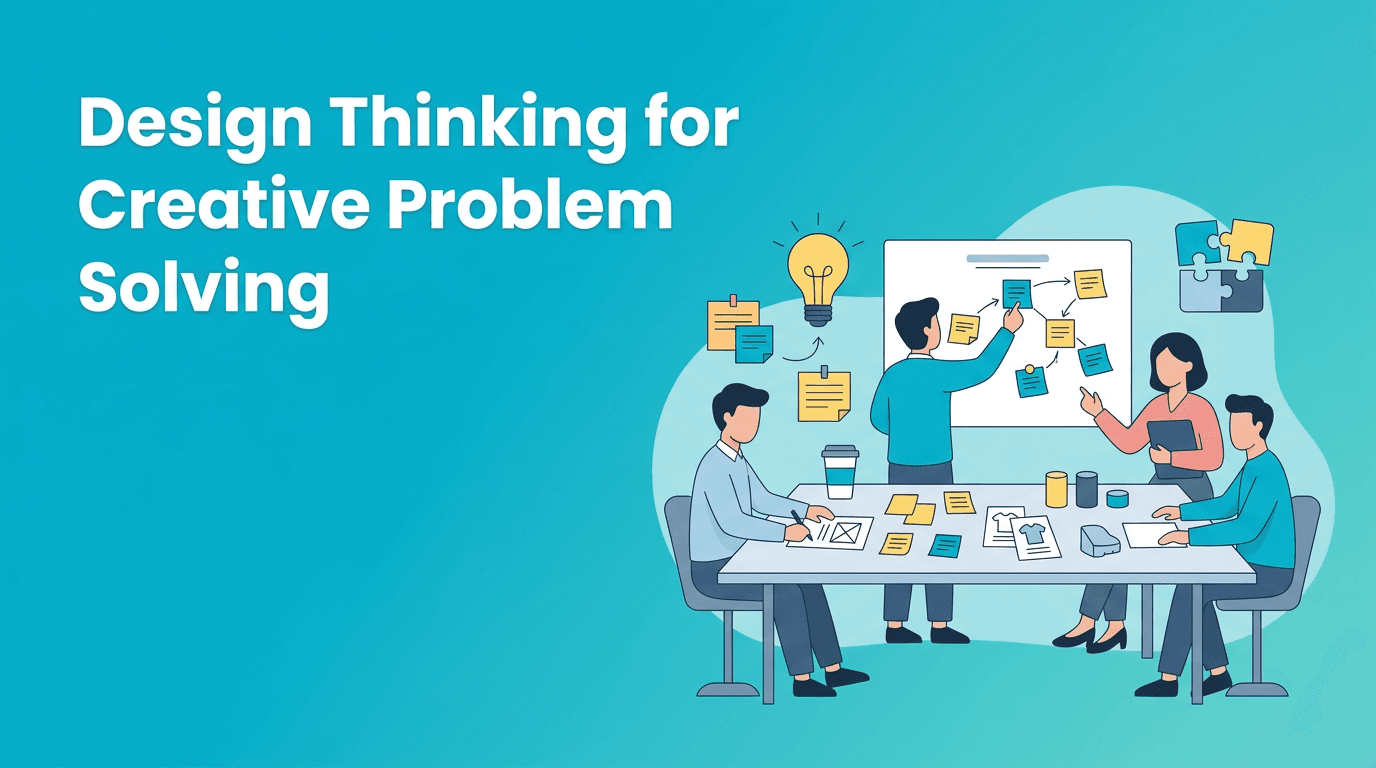
Design Thinking for Creative Problem Solving at Work
Design thinking helps professionals turn messy challenges into creative solutions. Learn a practical framework for problem solving, innovation, and stronger team ideas.

By Haply Team
Haply Editorial Team
Design thinking is one of the most practical ways to improve problem solving when the answer is not obvious. For professionals and entrepreneurs, it offers a repeatable path to better ideas, sharper innovation, and more useful creative solutions without waiting for inspiration to strike.
Why design thinking works for modern creative challenges
Many workplace problems are not purely technical. They involve people, habits, expectations, and uncertainty. That is why standard logic alone often falls short. Design thinking combines empathy, experimentation, and lateral thinking so you can explore what people actually need before investing time in the wrong solution.
- It helps teams define the real problem, not just the visible symptom.
- It encourages creative solutions through fast idea generation and testing.
- It reduces risk by validating ideas early.
- It improves innovation by making experimentation feel structured, not chaotic.
The 5-step design thinking process for better problem solving
1. Empathize with the real user
Start by observing, listening, and asking better questions. Whether your user is a customer, client, teammate, or audience, the goal is to understand frustrations, motivations, and workarounds. Strong problem solving begins when you stop assuming and start noticing.
2. Define the actual problem
A weak problem statement creates weak ideas. Instead of saying, "We need more engagement," say, "Busy users abandon onboarding because the first steps feel unclear and time-consuming." This reframing gives your team a target for creative solutions.
3. Ideate with lateral thinking
This is where lateral thinking matters. Instead of reaching for the first reasonable answer, force variety. Ask, "What would this look like if it had to be done in 2 minutes?" or "How would a magazine editor, game designer, or teacher solve this?" These prompts expand the solution space and strengthen innovation.
- Use time-boxed brainstorming to avoid overthinking.
- Generate at least 15 ideas before judging any of them.
- Combine opposing ideas to discover unexpected options.
- Look for analogies from other industries.
4. Prototype quickly
A prototype does not need to be polished. It can be a rough sketch, outline, landing page draft, workflow map, or mock conversation. The purpose is to make the idea testable. Fast prototypes turn abstract design thinking into visible action.
5. Test and refine
Share the prototype with real users and watch how they respond. Ask what confused them, what felt helpful, and what they expected next. Good problem solving is iterative. You do not fail when an idea needs revision, you learn what to improve next.
"Innovation rarely begins with a perfect answer. It begins with a better question."
How to use design thinking in everyday work
You do not need a full workshop or a big budget to apply this method. You can use design thinking in product decisions, content strategy, service design, hiring, internal processes, and even personal creative projects.
- For marketers: map where audience attention drops, then prototype a simpler message flow.
- For founders: interview 5 users before building the next feature.
- For managers: redesign meetings around one real decision instead of broad status updates.
- For creators: test multiple formats before committing to a full campaign.
Build creative momentum with Haply
When ideas feel scattered, Haply can help you turn insight into action. Its AI life coaching app includes Creativity coaches, an Idea Board, habit tracking, and personalized guidance to help you stay consistent and move from concept to execution.
Try Haply FreeCommon mistakes that weaken creative solutions
- Falling in love with the first idea too early.
- Confusing opinions with user evidence.
- Making prototypes too polished, which slows learning.
- Skipping lateral thinking and choosing only familiar options.
- Treating innovation as a one-time event instead of an ongoing practice.
A 20-minute design thinking sprint you can try today
If you want a simple starting point, run this solo or with a small team. It is especially useful when a project feels stuck.
- Spend 5 minutes writing what the user is struggling with.
- Spend 5 minutes reframing the issue into one clear problem statement.
- Spend 5 minutes generating at least 10 possible creative solutions.
- Spend 3 minutes choosing one low-cost prototype.
- Spend 2 minutes deciding how you will test it this week.
If consistency is your biggest challenge, tools like Haply can support the habit side of creativity. Its daily reminders, streak tracking, and chat-based coaching help professionals keep innovation alive between big bursts of inspiration.
Final thought on innovation and problem solving
The best creative work is not random. It comes from noticing people clearly, defining the right challenge, and testing ideas before overcommitting. Design thinking gives structure to uncertainty, helping you produce smarter creative solutions with less wasted effort.
Frequently Asked Questions
What is design thinking in simple terms?
Design thinking is a human-centered method for solving problems through empathy, idea generation, prototyping, and testing. It helps teams create useful and innovative solutions.
How does design thinking improve problem solving?
It improves problem solving by helping you understand the real user need, explore more options, and test ideas early. This reduces guesswork and leads to better decisions.
What is the difference between lateral thinking and design thinking?
Lateral thinking is a technique for generating unconventional ideas, while design thinking is a broader process for understanding problems and building solutions. Lateral thinking often fits inside the ideation stage of design thinking.
Can entrepreneurs use design thinking in small businesses?
Yes. Entrepreneurs can use design thinking to refine offers, improve customer experience, test new services, and find creative solutions without large budgets.