Haply Methodology Explained: The Science of Better AI Coaching
Curious about the Haply methodology? Learn how AI coaching science, microlearning coaching, personalized coaching, and behavior design make Haply more effective over time.

By Haply Team
Haply Editorial Team
The Haply methodology is built on a simple idea: meaningful personal growth happens when support is timely, specific, and easy to repeat. Instead of overwhelming people with long programs or generic advice, Haply uses short coaching sessions, behavioral psychology, and adaptive AI to help change stick in everyday life.
Why the Haply methodology starts with small steps
Many self-improvement tools fail because they ask too much, too soon. The Haply methodology takes the opposite approach. It assumes that motivation naturally rises and falls, attention is limited, and most people need help in the middle of real life, not just during ideal moments. That is why Haply, an AI life coaching app on iOS and Android, is designed around small actions with high follow-through.
- Short coaching loops reduce resistance and make it easier to begin.
- Daily repetition strengthens recall and builds consistency.
- Contextual support helps users act on advice when it matters most.
- Structured prompts turn reflection into decisions, not just ideas.
Microlearning coaching and why 10-15 minute sessions work
At the center of microlearning coaching is a practical insight from learning science: people retain and apply more when information is delivered in small, focused units. A 10-15 minute session is long enough to reflect, choose a next step, and commit to action, but short enough to fit into a real schedule.
This matters for coaching effectiveness. Long sessions can create insight, but insight alone does not guarantee behavior change. Short sessions are easier to repeat, which means users get more chances to practice awareness, decision-making, and follow-through. Over time, those repetitions matter more than occasional bursts of motivation.
"Lasting growth is usually not the result of one breakthrough. It is the result of many small moments of clarity followed by action."
What short sessions do better than long ones
- They lower the activation energy needed to start.
- They support spaced learning, which improves retention over time.
- They fit naturally into mornings, breaks, and evening resets.
- They make progress feel possible even on busy or emotionally heavy days.
AI coaching science: why habit streaks change behavior
The AI coaching science behind streaks is not about turning growth into a game for its own sake. Streaks work because they make consistency visible. When users can see a chain of completed actions, they are more likely to protect it. This taps into commitment, identity, and the motivational pull of not wanting to break a pattern.
Haply supports this with a habit tracker, streaks, daily reminders, and a Today Dashboard that keeps goals in view. These features are grounded in behavioral psychology: cues increase action, repetition strengthens routines, and visible progress reinforces the belief that change is actually happening.
Why streaks are effective when used well
- Immediate feedback makes effort feel real.
- Progress visibility helps users notice momentum.
- Daily reminders reduce reliance on memory alone.
- Identity reinforcement shifts the story from "I should" to "I am someone who does this."
How personalized coaching improves with use
A core strength of personalized coaching is relevance. Generic advice often fails because it ignores a person's goals, obstacles, pace, and patterns. Haply uses goal-based onboarding, chat-based sessions, and ongoing interaction signals to tailor support over time. The result is coaching that becomes more useful as the app learns what kind of encouragement, structure, and tools help a person move forward.
This is where coaching effectiveness improves. Personalization can adjust the tone, suggest the right mini-apps, and focus attention on the next best action instead of dumping broad recommendations. If someone struggles with focus, Haply can surface a Focus Timer or Task Planner. If stress is the issue, it can guide them toward breathing exercises, meditation, or sleep support. That makes the coaching feel practical, not abstract.
Why specialized coaches outperform generic chatbots
One reason the Haply methodology stands out is its use of specialized AI coaches across areas like Productivity, Wellness, Career, Learning, Finance, Creativity, and Relationships. A generic chatbot can respond to almost anything, but broad coverage often means shallow guidance. Specialized coaches are more likely to ask better questions, follow more relevant frameworks, and keep the conversation anchored to a clear outcome.
In practice, this means a productivity challenge is not treated like a relationship issue, and a career decision is not answered with the same vague encouragement used for stress management. Specialized coaching creates more structure, and structure is one of the biggest drivers of trust and progress in any coaching relationship.
- Domain-specific prompts create more relevant conversations.
- Clear frameworks improve decision quality.
- Focused tools reduce distraction and confusion.
- Consistent coaching logic helps users build momentum in one life area at a time.
The role of levels and achievements in behavior change
Gamification works best when it supports intrinsic motivation rather than replacing it. In Haply, levels and achievements are not random rewards. They function as markers of effort, consistency, and growth. This matters because behavior change is often emotionally invisible at first. People may be improving before they fully feel different. Progress markers help close that gap.
Used thoughtfully, gamification increases coaching effectiveness by making momentum easier to notice. A level gained or achievement unlocked can validate effort, especially during the early phase when habits still feel fragile. It gives users proof that small actions count.
Want a coaching system designed to help habits stick?
Try Haply to experience personalized sessions, specialized AI coaches, habit streaks, and practical mini-tools built on behavioral science.
Try Haply FreeWhy the design philosophy matters
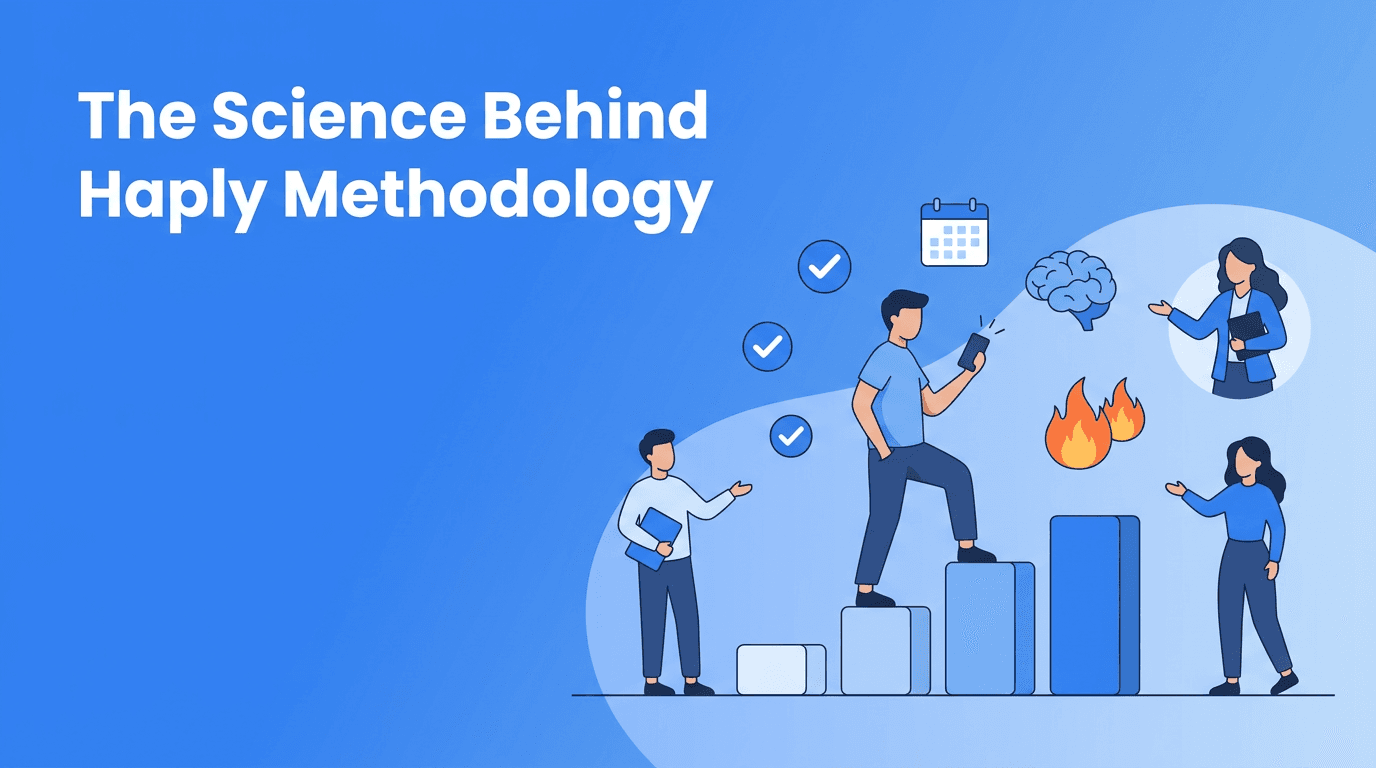
What makes the Haply methodology compelling is not any single feature. It is the way the pieces work together. Microlearning keeps sessions manageable. Personalization increases relevance. Streaks and reminders support consistency. Levels and achievements make progress visible. Specialized coaches improve quality. Together, these choices reflect a deeper philosophy: growth tools should meet people where they are and help them act today, not just think about change.
That is also why Haply is more than just another AI app. Its design reflects ideas from behavioral psychology, microlearning research, and coaching science. The goal is not endless conversation. The goal is real behavior change through repeated, supported action.
Frequently Asked Questions
What is the Haply methodology?
The Haply methodology is a coaching approach built around short sessions, personalized AI support, habit reinforcement, and specialized coaches for different life areas.
Why are 10-15 minute coaching sessions effective?
They are long enough for reflection and action planning, but short enough to repeat consistently. That repetition improves follow-through and learning retention.
How does personalized coaching get better over time?
As users interact with the app, the coaching can adapt to their goals, patterns, and obstacles. This makes future guidance more relevant and practical.
Do habit streaks actually help behavior change?
Yes, when used thoughtfully. Streaks make consistency visible, reinforce identity, and encourage people to continue actions they have already started.
Why are specialized AI coaches better than generic chatbots?
Specialized coaches can use more relevant frameworks, ask sharper questions, and give guidance suited to a specific life area, which improves clarity and usefulness.