Second-Order Thinking for Better Problem Solving at Work
Second-order thinking is a practical approach to problem solving that helps professionals avoid short-term fixes, improve design thinking, and create stronger innovation outcomes.

By Haply Team
Haply Editorial Team
Most workplace decisions fail not because the first idea is bad, but because the team never looks past the immediate effect. Second-order thinking is a practical method for problem solving that helps professionals and entrepreneurs predict consequences, reduce rework, and build more durable results. If you want stronger innovation without relying on random inspiration, this is one of the most useful mental models to learn.
Why second-order thinking matters for creative work
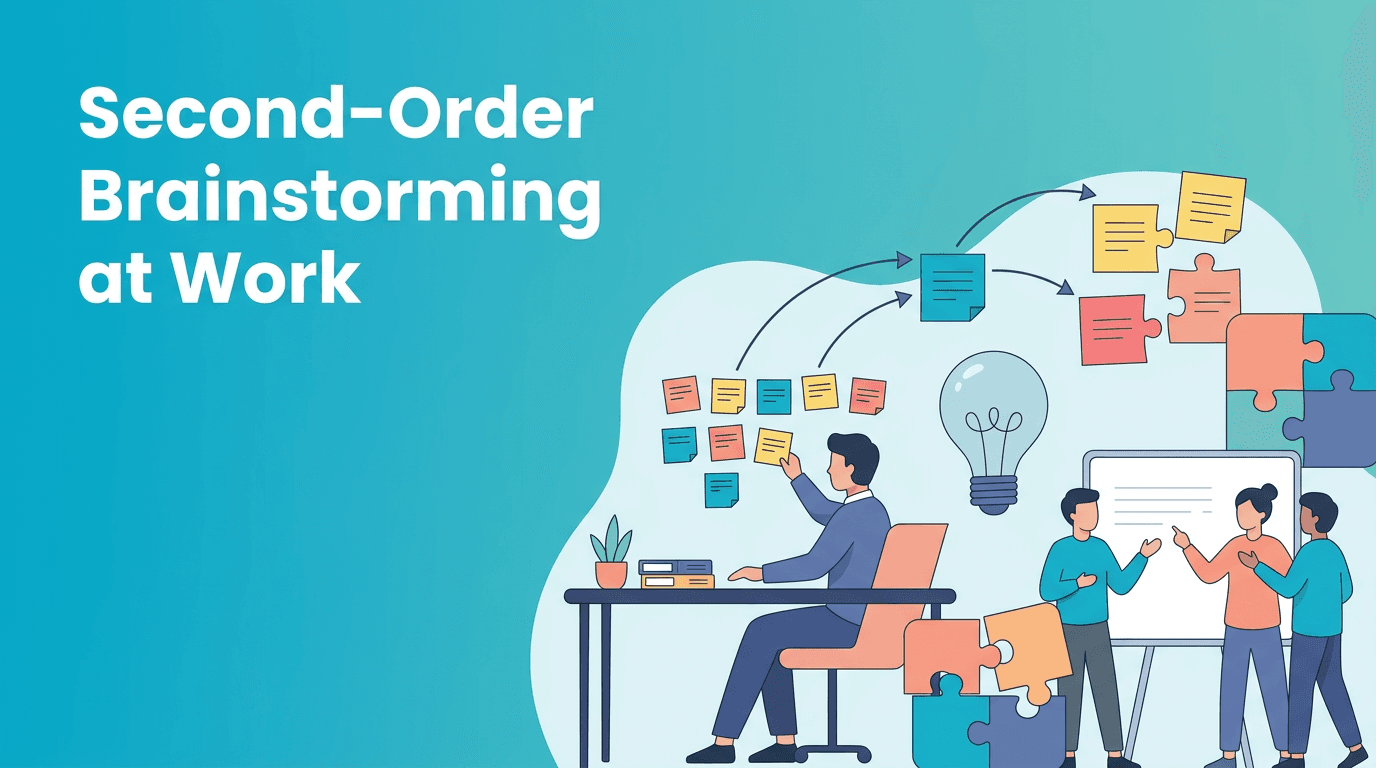
Creative professionals are often rewarded for speed, novelty, and visible action. But fast decisions can create hidden costs: rushed launches, confusing messaging, bloated workflows, and short-lived creative solutions. Second-order thinking adds a missing layer. Instead of asking, "What happens next?" you ask, "What happens after that, and then after that?"
- First-order thinking focuses on the obvious immediate outcome.
- Second-order thinking examines downstream effects, trade-offs, and unintended consequences.
- It strengthens problem solving by making ideas more realistic before execution.
- It supports design thinking because it keeps the user experience in view over time, not just at the first interaction.
- It complements lateral thinking by helping you test unusual ideas before you commit resources.
"Good ideas solve the visible problem. Great ideas also prevent the next one."
A simple framework for second-order problem solving
You do not need a complex strategy document to use second-order thinking. You need a repeatable set of prompts that slows your brain just enough to spot what others miss.
Step 1: Define the real problem
Many teams jump into solutions before naming the actual constraint. Ask: What problem are we truly trying to solve? A declining conversion rate, for example, may not be a copy problem. It could be a trust problem, a product clarity problem, or a mismatch between promise and delivery.
Step 2: Map the first-order result
Write down the most obvious expected outcome. If you shorten onboarding, users may sign up faster. If you add more features, customers may perceive more value. This step matters because it gives you a baseline before you move into deeper analysis.
Step 3: Ask what happens next
Now extend the chain. If onboarding is shorter, do users understand the product less? If you add more features, does the interface become harder to use? This is where design thinking becomes more powerful, because the focus shifts from a single touchpoint to the full experience journey.
Step 4: Look for system effects
Strong innovation comes from seeing systems, not isolated events. Ask how your decision affects team capacity, customer expectations, brand trust, pricing, support requests, and future options. A quick win that drains the system is rarely a real win.
Step 5: Pressure-test with lateral thinking
This is a smart moment to use lateral thinking. Instead of improving the current idea, ask unusual questions: What if we removed this step entirely? What if the customer solved it themselves? What if the opposite approach worked better? Novel options often emerge when you stop assuming the current structure is fixed.
A real-world example: solving the wrong marketing problem
Imagine a founder sees weak newsletter growth and decides to publish more content. First-order logic says more content should mean more traffic. But second-order thinking reveals deeper possibilities. More content may lower quality, confuse positioning, and increase team workload. It may also attract the wrong audience if the core message is unclear.
- A first-order fix: publish four times a week instead of two.
- A second-order question: will this improve trust, or just increase noise?
- A stronger response: clarify audience pain points, improve landing page messaging, and create fewer but sharper assets.
- The result: better problem solving because the team targets the leverage point, not the visible symptom.
How second-order thinking improves innovation
Many people treat innovation as idea generation. In practice, innovation is often idea selection. The best teams are not simply more imaginative. They are better at choosing ideas that survive contact with reality. Second-order thinking helps you evaluate whether a concept is scalable, defensible, and useful over time.
- It reduces excitement bias around flashy ideas.
- It improves prioritization when resources are limited.
- It helps leaders communicate trade-offs clearly.
- It leads to more resilient creative solutions.
- It creates better collaboration between strategy, design, marketing, and operations.
Build better thinking habits with Haply
If you want more consistent clarity, Haply can help you turn reflection into action. Use chat-based AI coaching, the Idea Board, and daily prompts to refine decisions, track experiments, and stay focused on meaningful progress.
Try Haply FreeDaily practices to train this skill
Like any creative discipline, second-order thinking gets stronger with repetition. You do not need to analyze every tiny decision. Focus on high-impact choices where consequences compound over time.
- Keep a decision journal and review whether your predicted outcomes actually happened.
- Before major choices, write three possible unintended consequences.
- During brainstorming, separate idea generation from consequence evaluation.
- Use a simple prompt in meetings: "What does this solve now, and what might it create later?"
- Try Haply on iOS or Android to set reminders, track decision experiments, and use AI coaching for clearer reflection.
When not to overuse second-order thinking
This method is powerful, but not every choice deserves deep analysis. Overthinking can become its own trap. For low-stakes tasks, speed matters more than precision. Use second-order thinking for strategic decisions, recurring problems, and expensive mistakes, not for every email, draft, or routine task.
Final takeaway
If your work depends on judgment, creativity, and long-term value, second-order thinking can upgrade how you approach problem solving. It works especially well alongside design thinking, lateral thinking, and other innovation methods because it helps you move from clever ideas to durable decisions. In fast-moving environments, the ability to think one step further is often the real competitive edge.
Frequently Asked Questions
What is second-order thinking in problem solving?
Second-order thinking is a decision-making method that looks beyond the immediate result and considers future consequences, trade-offs, and ripple effects.
How does second-order thinking help innovation?
It helps teams choose ideas that are sustainable, useful, and realistic, which leads to stronger innovation outcomes over time.
Is second-order thinking the same as design thinking?
No. Design thinking focuses on solving user problems creatively, while second-order thinking helps evaluate the downstream impact of those solutions.
How can I practice second-order thinking at work?
Use decision journals, ask what happens after the first result, and review unintended consequences before making major choices.