Systems Mapping for Creative Solutions: A Design Thinking Upgrade for Problem Solving
Creative solutions get stronger when problem solving starts with systems mapping. Learn how to use a design thinking lens to spot patterns, unlock innovation, and make better decisions at work.

By Haply Team
Haply Editorial Team
Most teams chase creative solutions by generating more ideas. But in complex work, better problem solving often starts earlier, with seeing the whole system before trying to fix one part. When you map relationships, bottlenecks, incentives, and hidden constraints, design thinking becomes sharper and innovation becomes more practical.
Why creative solutions fail when the system stays invisible
A lot of smart ideas fail for a simple reason: they solve the obvious symptom, not the deeper structure. A founder redesigns onboarding but ignores unclear pricing. A manager adds meetings but ignores decision friction. A creator buys new tools but ignores a chaotic workflow. Creative solutions are not just novel ideas. They are ideas that fit the reality people operate in.
- Symptoms are what people complain about first.
- Patterns are what keeps happening over time.
- Structures are the rules, habits, incentives, and dependencies causing those patterns.
- Leverage points are the small changes that produce outsized results.
"You do not rise to the level of your ideas. You fall to the level of your systems."
What systems mapping adds to design thinking
Traditional design thinking helps teams empathize, define, ideate, prototype, and test. That is useful, but many professionals skip a crucial layer: how every part of the challenge affects the others. Systems mapping adds that missing layer. It turns vague complexity into a visible model you can discuss, challenge, and improve.
A practical definition
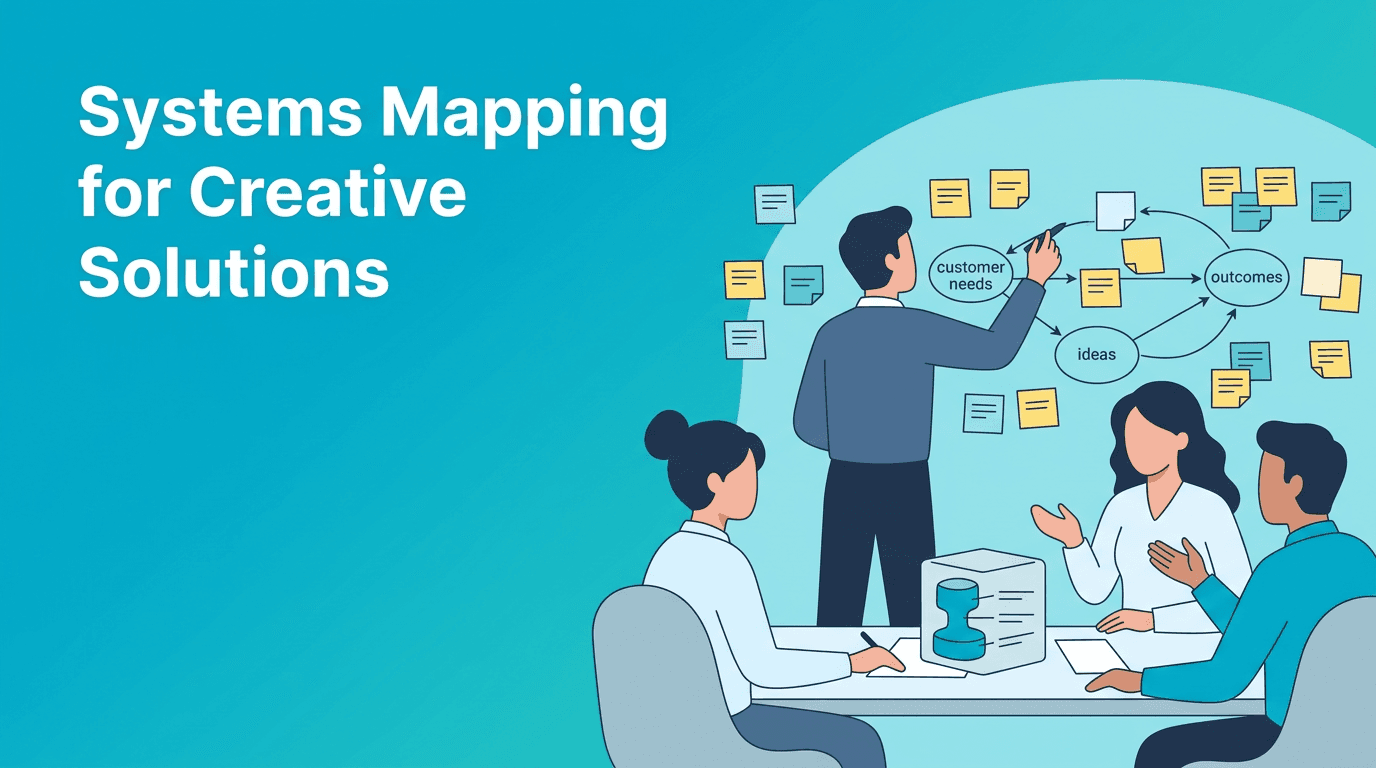
Systems mapping is a visual way to show how people, processes, tools, incentives, and delays interact around a problem. It strengthens problem solving because it reveals where effort is wasted, where feedback loops exist, and where one fix may create a new issue elsewhere.
- Use it when a problem keeps returning.
- Use it when multiple departments are involved.
- Use it when customers say one thing but behavior shows another.
- Use it when your team has ideas but no shared picture of the problem.
A 5-step method to build creative solutions with systems mapping
1. Define the outcome, not just the pain
Start with a target condition. Instead of saying, "Our pipeline is broken," say, "We want qualified leads to move from first contact to proposal in 10 days with fewer handoff delays." This keeps innovation grounded in a measurable result.
2. Map the actors and forces
List everyone and everything affecting the issue: customers, team members, software, approval steps, deadlines, metrics, habits, and unwritten rules. This is where lateral thinking helps. Look beyond the obvious and ask what indirect factor is quietly shaping outcomes.
3. Draw relationships and feedback loops
Connect the elements. Ask: what causes what? What slows what? What reinforces what? You may notice loops such as: unclear briefs create revisions, revisions create delays, delays increase stress, stress lowers clarity, and lower clarity creates more unclear briefs.
4. Find leverage points
Now look for interventions with disproportionate impact. The best creative solutions often come from changing one policy, one handoff, one template, or one decision rule rather than launching a giant initiative.
5. Prototype the smallest useful change
Test one change quickly. For example, replace open-ended project requests with a structured intake form for two weeks. Measure time saved, error reduction, or customer response. That is design thinking with operational discipline.
Examples of creative solutions in real work
For entrepreneurs
If customers are dropping off before purchase, do not only rewrite the landing page. Map the full decision journey. You may discover the real issue is trust, timing, or too many choices. A simpler offer, clearer proof, or faster follow-up could outperform a full rebrand.
For managers
If collaboration feels slow, map where decisions stall. Many teams think they need better brainstorming, but the real fix is clearer ownership. One decision matrix can create more innovation than ten idea sessions.
For creators and consultants
If your content pipeline is inconsistent, map your process from idea capture to publication. You may find that the bottleneck is not writing ability but idea retrieval, review delays, or context switching. This is where simple tools and routines unlock creative solutions.
Turn insight into action with Haply
Want help applying creative solutions to your work? Haply offers AI coaching for creativity, productivity, and career growth, plus tools like the Idea Board and Task Planner to help you move from scattered ideas to clear next steps.
Try Haply FreeHow to use lateral thinking without losing focus
Lateral thinking is valuable because it challenges default assumptions. But random idea generation is not enough. Use it after you have mapped the system. That way, your unusual ideas still target the real constraints.
- Ask, "What if we removed this step entirely?"
- Ask, "What would a beginner question here that experts ignore?"
- Ask, "What works in another industry that we could adapt?"
- Ask, "What happens if we optimize for speed, trust, or simplicity instead of volume?"
This sequence matters: first understand the system, then challenge the assumptions, then test a focused change. That is how problem solving becomes both imaginative and useful.
A weekly practice for innovation-minded professionals
You do not need a full workshop every time. Run a 20-minute weekly review. Pick one recurring friction point, map its inputs and outputs, identify one leverage point, and test one improvement. Over time, this creates a culture of steady innovation instead of sporadic inspiration.
- Monday - name one friction point
- Tuesday - map the system around it
- Wednesday - brainstorm 3 possible leverage points
- Thursday - test one small change
- Friday - review what improved and what still loops back
If you want structure, Haply can support this rhythm with chat-based coaching, reminders, streaks, and a personalized dashboard that keeps your experiments visible.
The real advantage of creative solutions
The strongest creative solutions are not just clever. They reduce friction, fit human behavior, and improve outcomes across the system. For professionals and entrepreneurs, that means less wasted effort, faster learning, and better execution. If you want more effective problem solving, stop asking only, "What idea should we try?" Start asking, "What system is producing this result?"
Frequently Asked Questions
What are creative solutions in problem solving?
Creative solutions are practical, original ways to solve challenges by combining insight, experimentation, and fit with the real system causing the problem.
How does design thinking help with complex problems?
Design thinking helps teams understand user needs, define the right problem, test ideas quickly, and learn from feedback before scaling a solution.
What is the difference between lateral thinking and design thinking?
Lateral thinking focuses on generating non-obvious ideas by challenging assumptions, while design thinking is a broader process for understanding needs, prototyping, and testing solutions.
How do you find innovation opportunities at work?
Look for repeated friction, delays, confusion, or workarounds. These patterns often reveal system issues where a small change can create meaningful innovation.