SCAMPER Technique: A Practical Framework for Better Problem Solving
The SCAMPER technique helps professionals unlock better problem solving with structured prompts that spark innovation, lateral thinking, and practical creative solutions.

By Haply Team
Haply Editorial Team
The SCAMPER technique is one of the simplest ways to improve problem solving when your team feels stuck on the first obvious idea. Instead of waiting for inspiration, this method gives you structured prompts that encourage innovation, lateral thinking, and more useful creative solutions.
For professionals and entrepreneurs, the value of SCAMPER technique is speed. You can apply it to a product, workflow, campaign, customer experience, or personal project in less than 20 minutes and quickly generate stronger options than a standard brainstorm.
What Is the SCAMPER Technique?
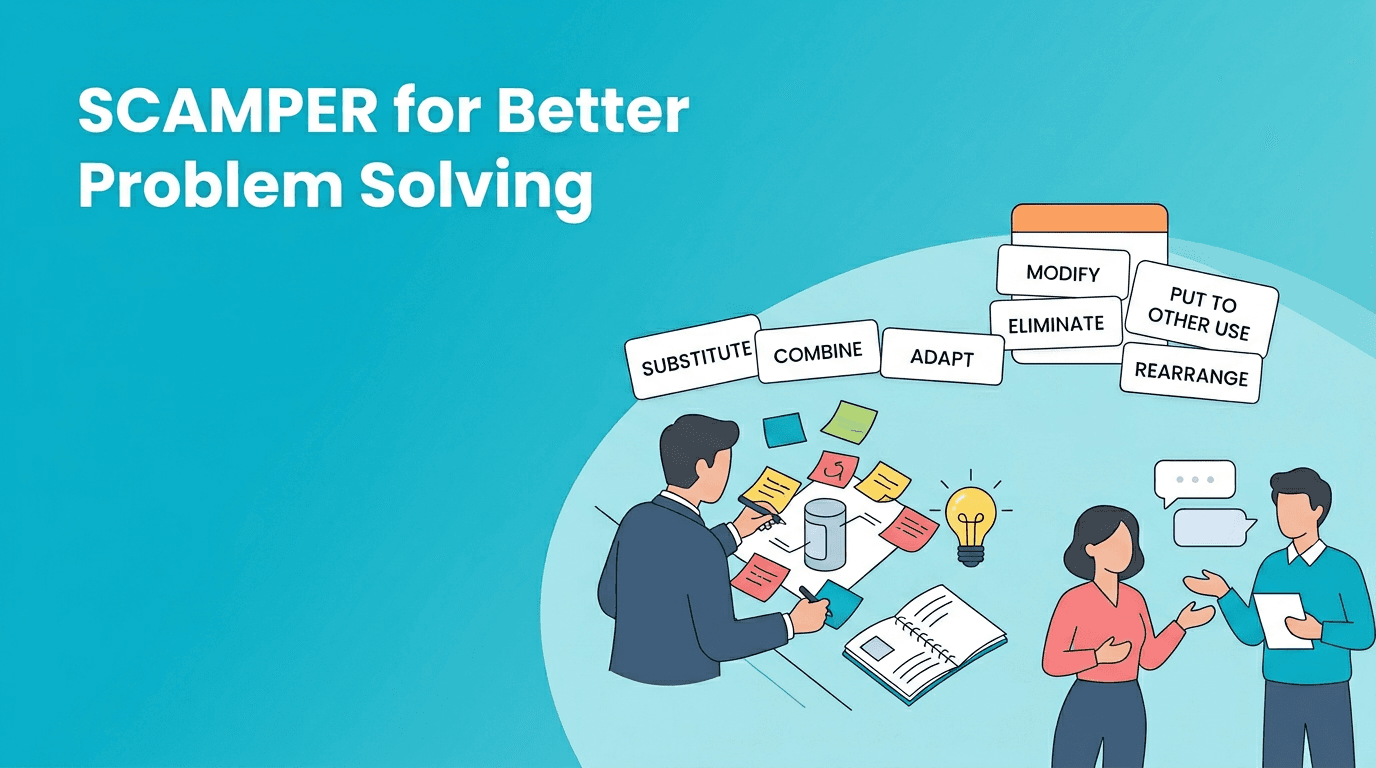
SCAMPER technique is a creativity framework built around seven prompts: Substitute, Combine, Adapt, Modify, Put to another use, Eliminate, and Reverse. Each prompt pushes you to look at the same challenge from a different angle, which makes it especially useful for problem solving and early-stage design thinking.
"You do not need a better idea first. You need better prompts."
Why It Works for Innovation
Many teams confuse brainstorming with creative depth. They collect quick ideas, then choose the least risky option. SCAMPER slows down that pattern just enough to widen the field. That is where innovation often begins, not with genius, but with a better set of questions.
- Substitute: What person, material, step, or channel could you replace?
- Combine: What two features, services, or audiences could be merged?
- Adapt: What similar solution from another industry could you borrow?
- Modify: What could you enlarge, simplify, speed up, or reshape?
- Put to another use: Can this asset solve a different problem?
- Eliminate: What can you remove to reduce friction or cost?
- Reverse: What happens if you flip the process, sequence, or assumption?
How to Use SCAMPER for Creative Problem Solving
Start with one clear challenge statement. For example: "How can we reduce customer onboarding time without sacrificing quality?" Then move through each SCAMPER prompt and force yourself to create at least three answers per prompt. This structure creates momentum and prevents idea fatigue.
A 15-Minute Team Exercise
- Write one problem solving question at the top of a page
- Set a timer for 2 minutes per SCAMPER prompt
- Generate at least 3 ideas before moving on
- Mark the ideas that are both original and realistic
- Choose 1 idea to test within the next 7 days
This process also pairs well with design thinking. Use SCAMPER after customer interviews or observation sessions, when you already understand user pain points and need more varied responses. It helps teams avoid defaulting to familiar fixes.
A Real-World Example: Improving a Service Offer
Imagine a consultant who wants to make a strategy package more attractive to small business clients. Instead of simply lowering the price, they use the framework: Substitute a long kickoff meeting with an async intake form, Combine strategy with accountability check-ins, Adapt a subscription model from software, Eliminate unnecessary deliverables, and Reverse the proposal flow by offering a short diagnostic first. In one session, they move from one weak idea to several stronger creative solutions.
Common Mistakes That Limit the SCAMPER Technique
- Using vague prompts without a specific challenge
- Judging ideas too early
- Stopping after one or two prompts
- Confusing unusual ideas with unusable ideas
- Skipping testing after the brainstorm
The biggest mistake is treating ideation as the finish line. The point of SCAMPER technique is not to produce clever notes on a whiteboard. The point is to create testable options. Even one small experiment can turn abstract lateral thinking into measurable business learning.
Build a stronger creative habit
Use Haply's AI coaching, habit tracker, and Idea Board to turn quick idea sessions into a repeatable creativity practice. Capture prompts, test new concepts, and stay consistent with daily reminders.
Try Haply FreeHow Haply Can Support Your Idea Process
If you want to make creativity more consistent, Haply can help. The app offers AI life coaching on iOS and Android, including support for Creativity goals. You can use the Idea Board mini-app to save SCAMPER prompts, the Task Planner to schedule experiments, and the habit tracker to build a steady ideation rhythm.
This matters because great innovation rarely comes from one breakthrough session. It comes from repeated cycles of observation, idea generation, testing, and reflection. A tool that keeps those cycles visible can improve follow-through.
Make SCAMPER Your Weekly Innovation Ritual
If you regularly face messy decisions, stalled products, or repetitive campaigns, the SCAMPER technique deserves a permanent place in your toolkit. It is simple enough for solo creators, structured enough for teams, and flexible enough to support everything from design thinking workshops to everyday problem solving.
The next time your first idea feels flat, do not ask for more inspiration. Ask better questions, move through the prompts, and turn fresh angles into practical action.
Frequently Asked Questions
What is the SCAMPER technique used for?
The SCAMPER technique is used to generate new ideas by changing an existing product, process, or challenge through seven creative prompts. It is useful for problem solving, innovation, and brainstorming.
How does the SCAMPER technique help with problem solving?
It helps with problem solving by forcing you to view the same issue from multiple angles. This often reveals options that standard brainstorming misses.
Is SCAMPER part of design thinking?
SCAMPER is not a formal stage of design thinking, but it works very well inside the ideation phase. Teams often use it after user research to create more varied concepts.
What are good SCAMPER examples at work?
Common workplace examples include improving onboarding flows, redesigning service packages, simplifying meetings, updating marketing offers, or repurposing existing assets for new audiences.