AI vs Human Coach: Which Coaching Comparison Helps You Grow Faster?
AI vs human coach is now a practical question for anyone exploring life coaching and online coaching. This coaching comparison breaks down costs, access, personalization, and when each option works best.

By Haply Team
Haply Editorial Team
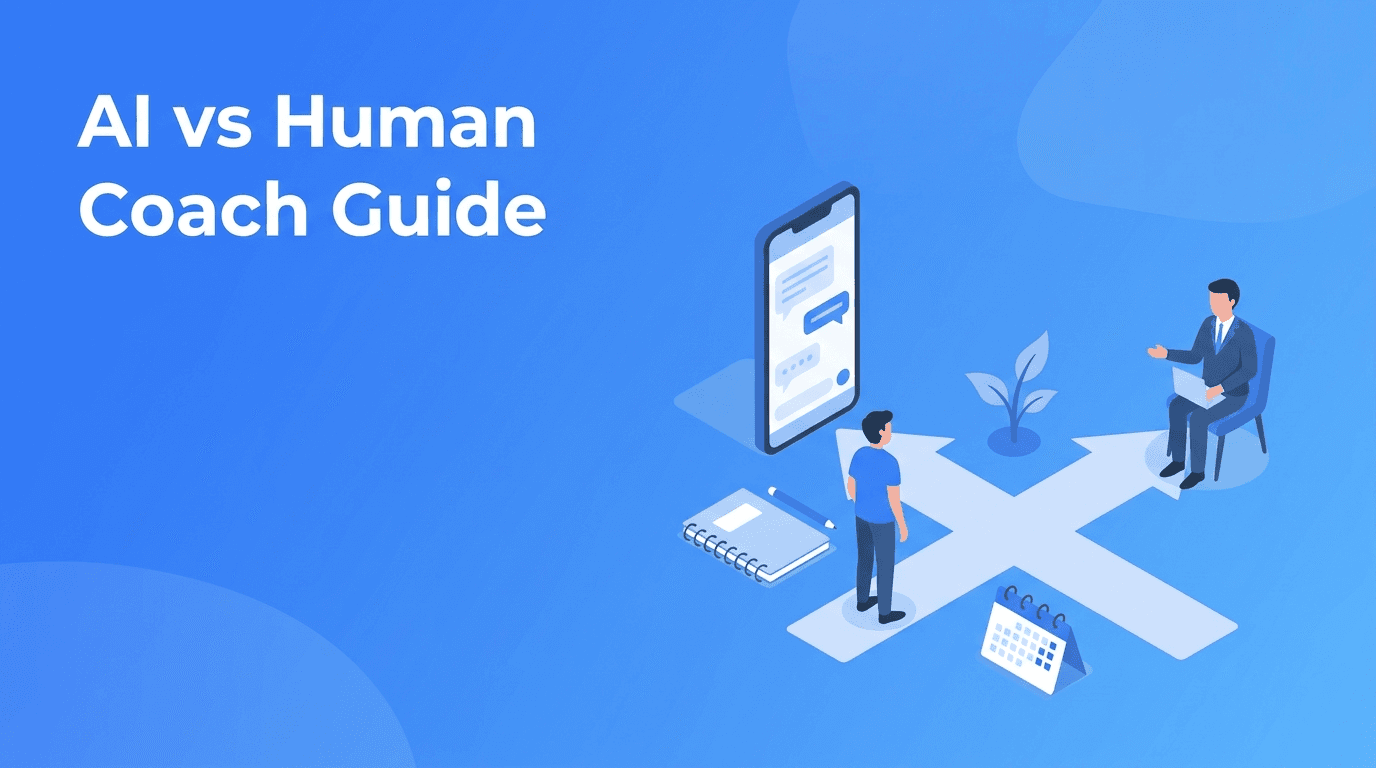
AI vs human coach is no longer a futuristic debate. It is a real decision for people choosing between life coaching, online coaching, and newer digital support tools. The best option depends less on hype and more on your goals, budget, schedule, and the kind of accountability you actually respond to.
Why this coaching comparison matters now
Coaching used to be limited by geography, price, and availability. Today, a person can book a traditional coach, join an online coaching program, or open an app and start a guided conversation in minutes. That shift makes a thoughtful coaching comparison more useful than a simple yes-or-no verdict.
- Choose a human coach when you want deep nuance, lived experience, and complex interpersonal feedback.
- Choose an AI coach when you want instant access, lower cost, frequent check-ins, and private reflection.
- Choose a blended approach when you want expert guidance plus daily support between sessions.
What an AI coach does well
An AI coach is strong at consistency. It can ask clarifying questions, help you break goals into steps, track habits, and prompt reflection at the exact moment you need it. For many people, that daily support matters more than occasional insight because progress often comes from repetition, not one breakthrough conversation.
Best use cases for AI life coaching
- Building routines for sleep, focus, exercise, or budgeting
- Planning weekly goals and reviewing what blocked progress
- Practicing self-reflection before difficult conversations
- Getting support outside business hours or across time zones
- Starting life coaching without a high financial commitment
Apps like Haply, an AI life coaching app on iOS and Android, make this model practical. You can chat with specialized coaches across productivity, wellness, career, learning, finance, creativity, and relationships. Features like a habit tracker, daily reminders, and mini-tools such as a Focus Timer or Task Planner turn insight into action.
"The most effective coaching is not just insightful. It is available at the moment a choice is made."
Where a human coach still has the edge
A human coach can detect subtle emotional patterns, challenge your blind spots in a highly contextual way, and adapt based on tone, history, and relational trust. In a close coaching comparison, this matters most when your situation is layered, emotionally charged, or tied to identity, leadership, or major life transitions.
Scenarios where human coaching may be better
- Navigating grief, burnout, or major career pivots with complex emotional factors
- Working through leadership dynamics, conflict, or executive presence
- Exploring long-term values, identity shifts, or relationship patterns
- Wanting a strong interpersonal bond that itself supports change
This does not mean AI is weak. It means the question is not whether technology replaces people. The better question is which format creates the right level of support for your current stage.
A practical coaching comparison: cost, access, and accountability
If you are comparing options, three factors usually decide the outcome: cost, access, and accountability. Traditional life coaching can be highly personalized, but it often comes with higher session fees and fixed schedules. AI coaching is usually more affordable and available any time, which increases follow-through for people who need frequent nudges.
- Cost: AI coaching is typically far less expensive than recurring one-to-one sessions.
- Access: AI support is available 24/7, which helps during real-life decision moments.
- Accountability: Human coaches may create stronger social pressure, but AI tools can create more frequent touchpoints.
- Privacy: Some people find it easier to be honest with an app before opening up to another person.
- Pace: AI works well for quick check-ins, while human sessions are often better for deeper exploration.
How to choose the right format for your goals
Use AI vs human coach as a decision framework, not a battle. If your main problem is inconsistency, an AI coach may outperform a human coach simply because it is present every day. If your main problem is complexity, a human coach may help you see patterns that are hard to uncover alone.
A simple decision checklist
- Pick AI coaching if you want affordable, flexible, daily support.
- Pick human coaching if you need depth, challenge, and nuanced feedback.
- Pick online coaching with both elements if you want sessions plus in-between accountability.
- Test one method for 2 to 4 weeks and measure results, not just motivation.
Try a lower-risk way to start coaching
If you are curious about coaching but not ready to commit to expensive sessions, Haply offers personalized, chat-based support, habit tracking, daily reminders, and a 7-day free trial.
Try Haply FreeThe future of coaching is likely hybrid
The most realistic future is not AI replacing coaches. It is a hybrid model where technology handles tracking, prompts, micro-reflection, and daily habit support, while humans focus on interpretation, complexity, and transformation. That combination can make coaching more accessible without flattening its quality.
This is especially relevant in online coaching, where the best experience often blends scheduled guidance with continuous support. A platform like Haply fits this shift well because it personalizes onboarding by goals, offers a Today Dashboard for daily direction, and reinforces progress through streaks and achievements.
What to ask before you invest in any coaching option
- What outcome do I want in the next 30 days?
- Do I need daily accountability or occasional deep conversation?
- What budget can I sustain consistently?
- Am I more likely to follow through with reminders, relationships, or both?
- How will I measure progress beyond feeling inspired?
Final takeaway on AI vs human coach
The best AI vs human coach answer is personal. A human coach may be ideal for complex growth work. An AI coach may be ideal for everyday momentum. For many people, the smartest coaching comparison leads to a blended strategy: human insight when needed, AI support every day. If your goal is to make life coaching more practical, measurable, and accessible, technology is already changing the game.
Frequently Asked Questions
Is AI vs human coach a fair comparison?
Yes, if you compare them by goal, budget, access, and accountability. They solve different parts of the coaching experience and can also work well together.
Can AI coaching replace life coaching?
For simple habit building and daily support, AI coaching can be enough for some people. For deeper emotional or complex personal challenges, a human coach may still be the better fit.
What is the difference between online coaching and AI coaching?
Online coaching usually means remote coaching with a human through video, messaging, or programs. AI coaching uses software to provide guided, personalized support and check-ins.
Is an AI life coach app worth trying?
It can be a cost-effective way to test coaching, especially if you want flexible support and structured habit tools. Look for apps that personalize guidance and make progress easy to track.