AI vs Human Coach: Which Type of Life Coaching Fits Your Real Needs?
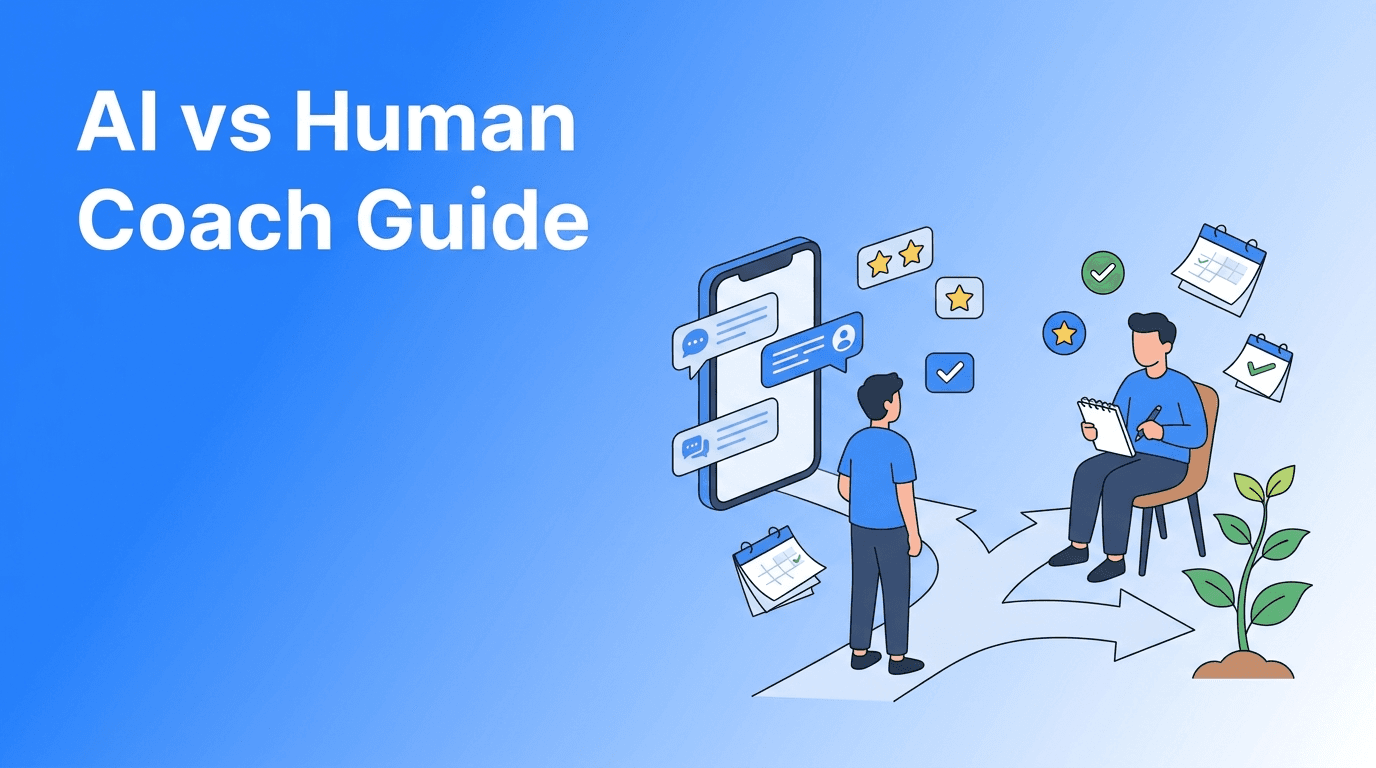
AI vs human coach is no longer a theoretical debate. This guide compares life coaching and online coaching options so you can choose the support style that fits your goals, budget, and daily routine.

By Haply Team
Haply Editorial Team
The question of AI vs human coach matters because more people now have access to life coaching through apps, chat platforms, and virtual sessions. If you are choosing between traditional support and online coaching, the best option is usually not the most impressive one, but the one you will actually use consistently.
A useful coaching comparison starts with your real constraints: budget, privacy needs, schedule, emotional complexity, and how often you want guidance. Some people need deep relational accountability. Others need fast, structured reflection in the exact moment a decision shows up.
Why the AI vs human coach decision is growing now
Coaching used to be limited by geography, price, and availability. Technology changed that. With online coaching, support can now happen through video calls, messaging, or app-based conversations. This expansion has made coaching more flexible, but it has also made the decision more confusing.
- Human coaching often offers nuance, emotional presence, and real-time relational feedback.
- AI coaching tools often offer speed, lower cost, daily access, and structured prompts.
- Hybrid models combine both, giving people continuous support between sessions.
- The best choice depends less on trend and more on your specific use case.
The best coaching is not the one with the most prestige. It is the one that helps you take the next honest step.
What human coaching does especially well
Relational depth and emotional nuance
A skilled human coach can notice tone, hesitation, contradiction, and context in ways that can feel deeply validating. In emotionally complex areas like grief, conflict, identity shifts, or burnout, that relational attunement can be highly valuable.
Challenge that feels personal
Many people choose life coaching because they want more than advice. They want someone to challenge assumptions, spot blind spots, and hold them accountable in a relationship that evolves over time. A human coach can often do this with more sensitivity when stakes are high.
- Best for complex emotional situations
- Useful when you want a long-term coaching relationship
- Strong fit for people who respond to interpersonal accountability
- Often better when goals involve identity, leadership, or major transitions
What AI coaching does especially well
Consistency, access, and low friction
In the AI vs human coach debate, one major advantage of AI is availability. You do not need to wait a week for your next session to reflect on a stressful meeting, reset a habit, or clarify tomorrow's priorities. That immediacy can turn insight into action faster.
AI systems are also strong at structured reflection. They can guide you through prompts, progress reviews, habit check-ins, and scenario planning without making support feel like a major appointment. For many people, this reduces the friction that stops personal development from becoming a routine.
- Available any time, including small moments during the day
- Usually more affordable than traditional coaching
- Helpful for daily habits, focus, planning, and reflection
- Easy to integrate into online coaching routines and digital tools
Want a practical way to test AI coaching?
Haply is an AI life coaching app on iOS and Android with specialized coaches for productivity, wellness, career, learning, finance, creativity, and relationships. It also includes habit tracking, daily reminders, mini-apps, and a personalized onboarding flow so you can try structured coaching in real life, not just in theory.
Try Haply FreeLimits to keep in mind in any coaching comparison
A balanced coaching comparison should include tradeoffs. AI can be excellent for clarity, habit support, and decision structure, but it may not replace the felt experience of being deeply understood by another person. Human coaching can be powerful, but it can also be expensive, inconsistent between sessions, or difficult to access regularly.
- AI limits: less human presence, variable depth, not ideal for crisis support
- Human limits: higher cost, scheduling friction, uneven availability
- Online coaching limits: quality varies widely across platforms and providers
- Best practice: match the tool to the problem, not the hype
How to choose the right format for your goals
Choose AI support if you need repetition and momentum
If your main challenge is not insight but consistency, AI may be the stronger option. This is especially true when you need brief check-ins, reminders, mindset reframes, or help breaking big goals into smaller actions.
Choose a human coach if you need depth and interpretation
If you are working through a major life transition, leadership challenge, or emotionally layered pattern, a human coach may offer better support. The value often comes from interpretation, presence, and the trust built over time.
Choose a hybrid approach if you want both
Many people do best with both. A human coach can guide the deeper arc of growth, while an AI tool supports the everyday work between sessions. For example, Haply can help with daily reflection, task planning, streaks, and habit reminders while a human coach handles higher-level strategy.
A simple decision checklist for AI vs human coach
- Do you want support daily or weekly?
- Is your main issue habit follow-through or emotional complexity?
- What is your realistic monthly budget?
- Do you prefer chat-based reflection or live conversation?
- Will you use support more if it is available in two minutes instead of two days?
- Do you want one tool for coaching plus practical features like a Focus Timer, Task Planner, meditation, or a Today Dashboard?
The future of life coaching will likely be blended
The future is probably not a winner-take-all story about AI vs human coach. More likely, life coaching will become layered. Humans will provide interpretation, ethics, and deep relational work. Technology will provide access, repetition, personalization, and real-world behavioral support.
That shift could make online coaching more inclusive. People who cannot afford ongoing private sessions may still benefit from guided reflection, goal tracking, and personalized prompts. In that sense, technology is not just changing coaching delivery. It is expanding who gets to participate in personal development at all.
Frequently Asked Questions
Is AI vs human coach a real choice or should I use both?
It depends on your goals. If you need daily structure and affordable support, AI may be enough. If you need deeper relational work, a human coach or a hybrid approach is often better.
Is online coaching as effective as in-person life coaching?
Online coaching can be very effective when the format matches your needs. Many people value the convenience, but quality depends on the coach, the platform, and how consistently you engage.
What is the biggest difference between AI coaching and life coaching with a person?
The biggest difference is relational depth versus constant availability. Human coaches often provide deeper emotional nuance, while AI tools provide faster, more frequent support.
Who should choose an AI coach first?
People who want affordable, immediate, and structured help with habits, planning, self-reflection, or motivation often benefit most from starting with AI coaching.