AI vs Human Coach: How to Choose the Right Support for Your Next Growth Goal
AI vs human coach is no longer a simple tech debate. This guide breaks down coaching comparison factors, life coaching use cases, and online coaching options to help you choose wisely.

By Haply Team
Haply Editorial Team
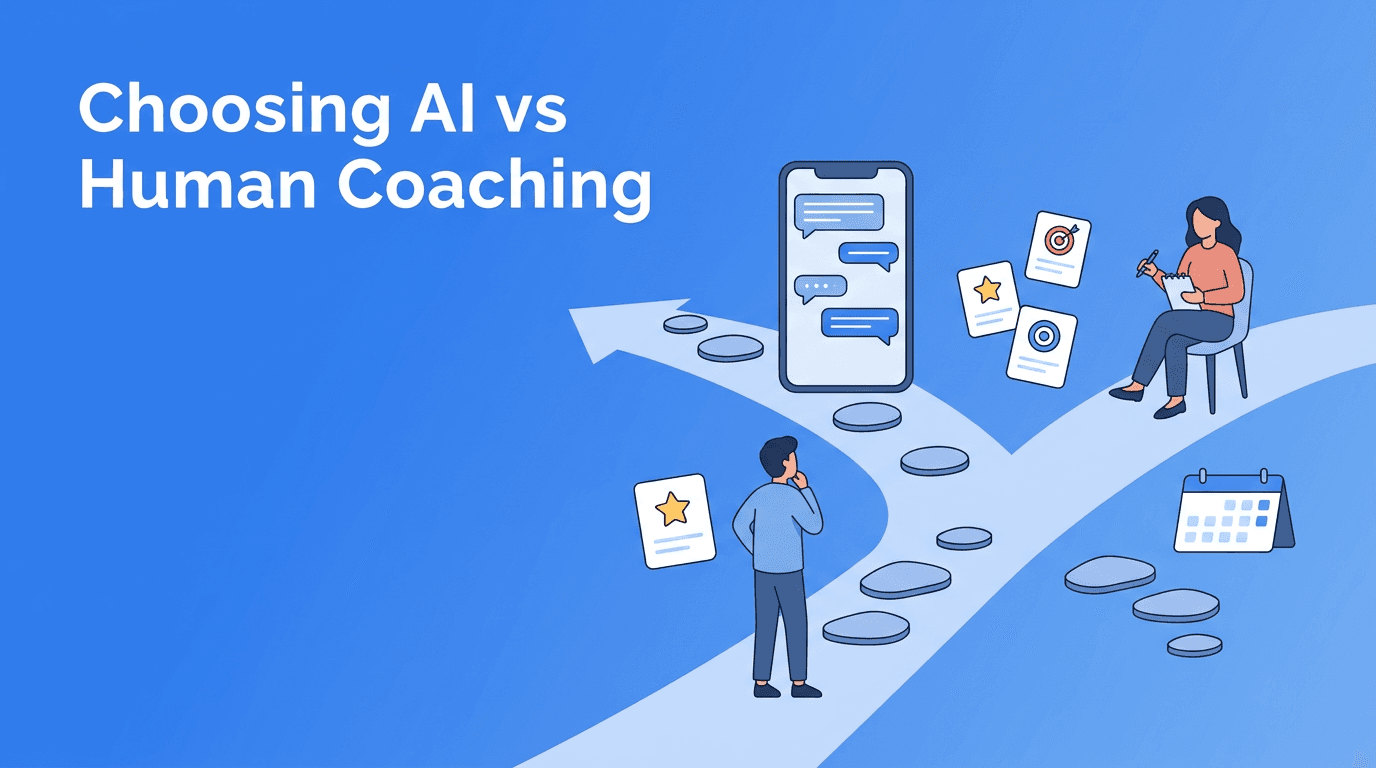
The question of AI vs human coach matters most when you are trying to solve a real problem, not when you are debating technology in the abstract. If you are weighing life coaching or online coaching, the best choice depends on your goal, budget, need for nuance, and how often you want support between sessions.
Why the AI vs human coach decision is more practical than philosophical
Many people frame coaching as a binary choice: either a person understands you, or software cannot. In reality, a useful coaching comparison starts with daily behavior. Do you need fast check-ins, structured prompts, and reminders? Or do you need deep interpretation, emotional nuance, and high-stakes guidance? The answer often changes by situation.
- Choose AI support when you want frequent, low-friction check-ins and help turning intentions into repeatable actions.
- Choose a human coach when your challenge involves identity shifts, complex relationships, leadership tension, or emotionally layered decisions.
- Consider a hybrid approach when you want strategic human guidance plus daily digital accountability.
What AI coaching does especially well
AI coaching is strongest when progress depends on consistency. A digital coach can help you break a vague goal into smaller steps, reflect in the moment, and stay engaged on ordinary days when motivation dips. That is why many people exploring online coaching now use AI for the day-to-day layer of support.
Strengths of AI for everyday follow-through
- Availability: You can check in at night, during a commute, or between meetings.
- Lower cost: AI tools often cost far less than recurring one-to-one sessions.
- Reduced friction: It is easier to ask for help in the exact moment you need it.
- Pattern tracking: Apps can notice streaks, missed habits, and recurring obstacles over time.
- Structured practice: AI can guide journaling, planning, breathing, focus sessions, and review routines.
The best coaching system is not always the most insightful one. It is often the one you will actually use on a difficult Tuesday.
For example, Haply is an AI life coaching app on iOS and Android that supports areas like productivity, wellness, career, learning, finance, creativity, and relationships. Its chat-based coaching, daily dashboard, habit streaks, and mini-tools such as a Focus Timer or Task Planner can make personal development easier to sustain between bigger decisions.
Where human coaching still has a clear advantage
A human coach brings context, intuition, and relational depth that current AI cannot fully replicate. In a thoughtful AI vs human coach decision, this matters when your goal is emotionally complex or tied to values, conflict, grief, leadership pressure, or major life transitions.
When a human coach may be worth the premium
- You need live challenge and interpretation based on tone, hesitation, and subtle cues.
- You are navigating sensitive personal history or emotionally intense patterns.
- You want a strong interpersonal relationship that itself becomes part of the growth process.
- You are making a career, relationship, or identity decision with broad consequences.
- You benefit from dedicated session space that creates seriousness and commitment.
This is why life coaching has not been replaced. It has become more layered. Human coaches often deliver the highest value in strategic conversations, while technology increasingly supports execution between those conversations.
A simple coaching comparison framework before you spend money
Before choosing any format, score your situation across five factors. This helps you move beyond hype and into a realistic coaching comparison.
- Goal clarity: If your goal is clear, AI may be enough to help you execute. If it is unclear, a human can help define it.
- Emotional complexity: The more emotionally loaded the issue, the more helpful human nuance becomes.
- Frequency of support: If you need help daily, AI is usually more practical than waiting for weekly sessions.
- Budget: Ongoing human coaching can be expensive. AI often expands access for people who would otherwise get no support.
- Self-direction: If you are comfortable experimenting and reflecting, digital coaching can work very well.
Want to test coaching support before committing?
Try Haply if you want chat-based guidance, habit tracking, reminders, and goal-based onboarding without the cost or scheduling burden of traditional coaching.
Try Haply FreeThe future of coaching is likely hybrid, not winner-take-all
The future of coaching will probably not be a battle where one side eliminates the other. More likely, we will see a layered model: AI handles repetition, reminders, practice, and real-time reflection, while humans focus on nuance, trust, and transformation in moments that require deep judgment.
This matters because most personal growth fails in the gap between insight and action. Technology-powered personal development can close that gap by making support continuous rather than occasional. That is one reason the AI vs human coach conversation is becoming less about replacement and more about role design.
What this future could look like in practice
- A human coach helps you define a 90-day direction.
- An AI coach helps you turn that direction into weekly actions and daily check-ins.
- Progress data from habits, mood, focus, sleep, or planning tools informs future sessions.
- The user gets both depth and consistency, instead of having to choose just one.
How to choose the right format for your next goal
If your main challenge is consistency, procrastination, planning, or habit follow-through, start with digital support first. If your challenge is emotionally complex, relational, or high stakes, start with a person. If you can afford both, use a hybrid system and assign each format a clear role.
Frequently Asked Questions
Is AI vs human coach a real choice or should I use both?
For many people, both is the best answer. AI can support daily action, while a human coach can help with deeper strategy and emotional nuance.
What is better for life coaching, AI or a human coach?
It depends on the goal. AI is often better for routines, reminders, and structured reflection, while human coaching is stronger for complex personal decisions and emotionally layered challenges.
How does online coaching compare to AI coaching apps?
Online coaching usually means scheduled sessions with a person, while AI coaching apps provide on-demand support. The main tradeoff is human depth versus everyday accessibility.
Can an AI coach replace a human coach completely?
Not in every case. AI can be highly effective for accountability and habit support, but human coaches still offer relational insight and judgment that matter in complex situations.