Attention Residue: The Hidden Focus Leak Hurting Personal Development
Attention residue quietly drains your focus, confidence, and self-awareness. Learn how to reduce mental carryover, build positive habits, and create real life improvement.

By Haply Team
Haply Editorial Team
Attention residue is one of the biggest hidden reasons busy people feel distracted even when they are trying hard to grow. If your personal development plan looks good on paper but your brain still feels scattered, the problem may not be motivation. It may be the mental leftovers from constantly switching tasks, tabs, conversations, and goals.
This matters because scattered attention affects more than productivity. It weakens self-awareness, chips away at confidence, and makes life improvement feel harder than it should. The good news is that you do not need a perfect routine. You need a simpler way to protect your attention.
What attention residue actually means
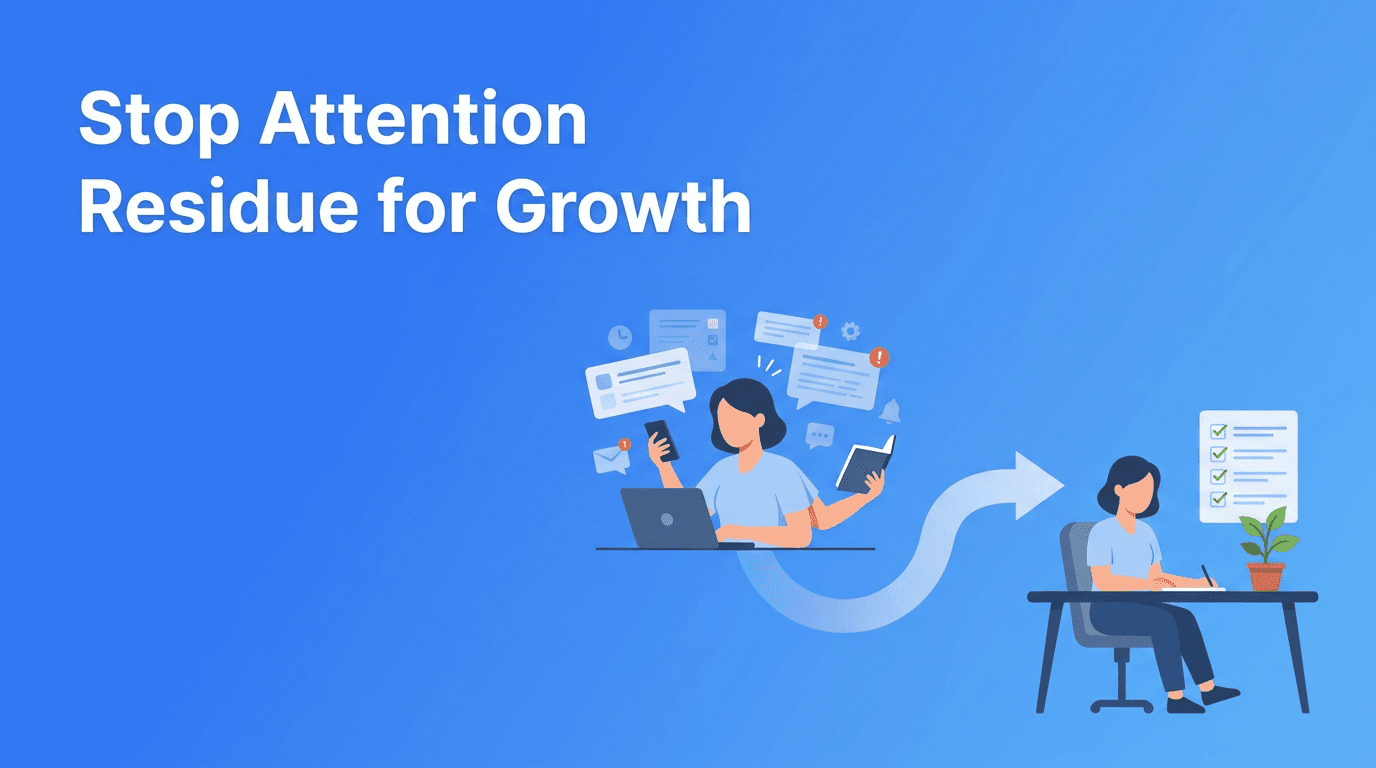
Attention residue happens when part of your mind stays stuck on the last task while you are trying to start the next one. You may physically move on, but mentally you are still replaying the email, the unfinished errand, or the awkward message you have not answered.
- You open a book, but keep thinking about work
- You start a workout, but mentally stay inside a stressful meeting
- You journal at night, but your brain keeps scanning tomorrow's to-do list
- You try to rest, but part of you is still solving unfinished problems
"Where your attention goes, your growth follows."
Why attention residue hurts confidence and self-awareness
When your mind is split, your results become inconsistent. You may assume you lack discipline, but often you are simply overloaded. This misunderstanding can damage confidence because you start labeling yourself as lazy, unfocused, or bad at following through.
It also reduces self-awareness. When you never pause long enough to notice what is pulling on your mind, you cannot accurately see your patterns. Instead of asking, "What is draining my attention?" you ask, "What is wrong with me?" That is the wrong question.
The personal development trap
Many people keep adding more tools for life improvement without fixing attention leaks first. They download another planner, start another challenge, or set bigger goals. But growth gets easier when you remove friction before adding complexity.
- Before adding a new habit, reduce unnecessary task switching
- Before blaming low motivation, check for unfinished mental loops
- Before setting a bigger goal, make sure your current goals are clear
- Before chasing more output, protect your transition time between tasks
5 practical ways to reduce attention residue
1. Use a 60-second task closure ritual
Before switching tasks, take one minute to close the loop. Write down what you finished, what remains, and the next step. This small act tells your brain, "You do not need to keep holding this." It is one of the fastest positive habits you can build.
2. Group similar thinking together
Try batching tasks that use the same kind of mental energy. Do writing with writing, admin with admin, planning with planning. Fewer context switches mean less attention residue and more clean focus.
3. Create a reset between roles
If you move from work mode to partner mode, parent mode, study mode, or rest mode, use a short reset. Walk for two minutes, breathe slowly, stretch, or write one line about what matters next. This improves self-awareness because you notice the shift instead of dragging old stress forward.
4. Keep fewer open promises to yourself
Every vague intention takes up space. If you tell yourself you should start a course, fix your sleep, call a friend, clean the closet, and plan your finances all at once, your mind stays crowded. Choose fewer priorities and define the next action clearly.
5. End the day with a mind sweep
Spend five minutes listing unfinished thoughts, worries, reminders, and ideas. This reduces mental carryover into your evening and helps you sleep with less noise. Over time, this supports both confidence and life improvement because you feel more in control of your inner world.
Need help turning insight into action?
Haply is an AI life coaching app for iOS and Android that helps you build positive habits, track progress, and get personalized support across productivity, wellness, career, and more. Use tools like the Focus Timer, Task Planner, and Today Dashboard to reduce mental clutter and stay consistent.
Try Haply FreeA simple daily system for life improvement
If you want a realistic system, keep it small. Busy people do not need an elaborate reset protocol. They need a repeatable structure that works on normal days.
- Morning: choose your top 1 to 3 priorities
- Midday: pause for a one-minute closure before switching tasks
- Evening: do a quick mind sweep and plan tomorrow's first step
- Weekly: review what keeps stealing your attention and remove one source of friction
This kind of system supports personal development because it builds awareness and action together. You are not just trying harder. You are designing better conditions for focus.
How Haply can support deeper focus
If you struggle to stay consistent alone, Haply can make the process easier. Its chat-based AI coaches can help you spot patterns, strengthen self-awareness, and create routines that fit your real life. You can also use habit tracking, reminders, and mini-apps like the Focus Timer and Meditation tools to reduce distraction and stay grounded.
Final thought: protect your attention before you push harder
Real growth does not always come from doing more. Sometimes it comes from carrying less mental residue into the next moment. If you want more confidence, stronger positive habits, and steady life improvement, start by noticing what your mind is still holding. Clearer attention creates clearer action.
Frequently Asked Questions
What is attention residue in simple terms?
Attention residue is the leftover mental focus from one task that stays with you when you move to another task. It makes it harder to fully concentrate on what you are doing now.
How do I reduce attention residue quickly?
Use a short closure ritual before switching tasks. Write down what you finished, what remains, and the next step so your brain does not keep replaying it.
Can attention residue affect confidence?
Yes. When focus drops, people often blame themselves instead of the constant task switching causing the problem. That can lower confidence over time.
What habits help improve focus and self-awareness?
Task batching, transition resets, mind sweeps, and clear daily priorities are effective habits. They reduce mental clutter and help you notice your patterns earlier.