Evidence-Based Coaching: How AI Makes Personal Development More Measurable
Evidence-based coaching is reshaping personal development by making reflection, behavior change, and progress tracking more measurable. Learn how AI coaching turns proven psychology into daily action.

By Haply Team
Haply Editorial Team
Evidence-based coaching is changing the logic of personal development. Instead of relying only on motivation or vague inspiration, it asks a sharper question: what methods actually help people change? In the age of AI, that question becomes even more practical, because coaching tools can now support reflection, track patterns, and reinforce behavior change in ways that are consistent, personalized, and measurable.
For analytically-minded people, this shift matters. Traditional self-help often offers ideas without feedback loops. By contrast, coaching psychology, positive psychology, and habit science provide frameworks that can be tested in real life. AI coaching extends those frameworks into everyday moments, where intentions usually succeed or fail.
Why evidence-based coaching matters now
At its core, evidence-based coaching combines research, practitioner skill, and client context. That means useful coaching is not just inspirational, and it is not rigidly clinical either. It draws from findings in psychology, goal-setting theory, motivation research, and learning science, then applies them to the messy reality of human life.
- Research offers models for motivation, self-regulation, and habit formation.
- Coaching psychology translates those models into structured conversations and experiments.
- Behavior change happens when insight is converted into repeated action under real-world constraints.
- Measurement helps people see whether a strategy is working or merely feels productive.
"What gets measured improves, but only when measurement leads to reflection rather than pressure."
The science behind better coaching conversations
One reason evidence-based coaching stands out is that it respects how change actually happens. People rarely transform because of a single breakthrough. More often, progress comes from a cycle: awareness, experiment, feedback, adjustment, repetition. This aligns closely with research on self-regulation and metacognition.
How coaching psychology structures growth
Coaching psychology focuses on helping people set meaningful goals, increase self-awareness, and sustain action. Instead of diagnosing pathology, it often centers on functioning, adaptation, strengths, and performance. In practice, that means a coach might help someone identify friction points in their routine, test a new behavior for a week, then review the result without judgment.
Where positive psychology fits
Positive psychology contributes another useful layer. It studies strengths, optimism, wellbeing, meaning, and engagement. In coaching, this can prevent growth work from becoming purely deficit-focused. Rather than asking only "What is wrong?", a more productive question is "What conditions help you function at your best, and how can you recreate them more often?"
- Use strengths-based reflection to identify what energizes consistent action.
- Apply implementation intentions like "If it is 7 p.m., I start my 10-minute planning session."
- Track small wins to reinforce motivation and perceived competence.
- Review setbacks as data, not proof of failure.
How AI supports evidence-based coaching in daily life
AI does not replace the entire coaching process. Its real advantage is operational. It can make proven coaching principles available at the exact moments when people need support, not only during occasional sessions. This is where technology becomes powerful for behavior change.
For example, an AI life coaching app like Haply can turn abstract goals into structured daily interactions. A user might begin with goal-based onboarding, then receive chat-based coaching, daily reminders, progress streaks, and tools like a Focus Timer or Task Planner. This creates a practical system where reflection and action remain connected.
- Personalization at scale - AI can adapt prompts based on goals, routines, and previous responses.
- Consistency - daily check-ins reduce the gap between intention and follow-through.
- Pattern detection - recurring obstacles become easier to spot when reflections are logged over time.
- Immediate support - users can get coaching input during decision points, not days later.
- Low-friction experimentation - people can test routines, review outcomes, and iterate quickly.
Try AI coaching grounded in daily practice
If you want a structured way to apply evidence-based coaching principles, Haply offers personalized AI coaching, habit tracking, and mini-tools for productivity, wellness, learning, and more.
Try Haply FreeA practical model: from insight to behavior change
The most useful way to understand evidence-based coaching is as a sequence of testable steps. This is especially relevant for people who prefer systems thinking over vague motivation.
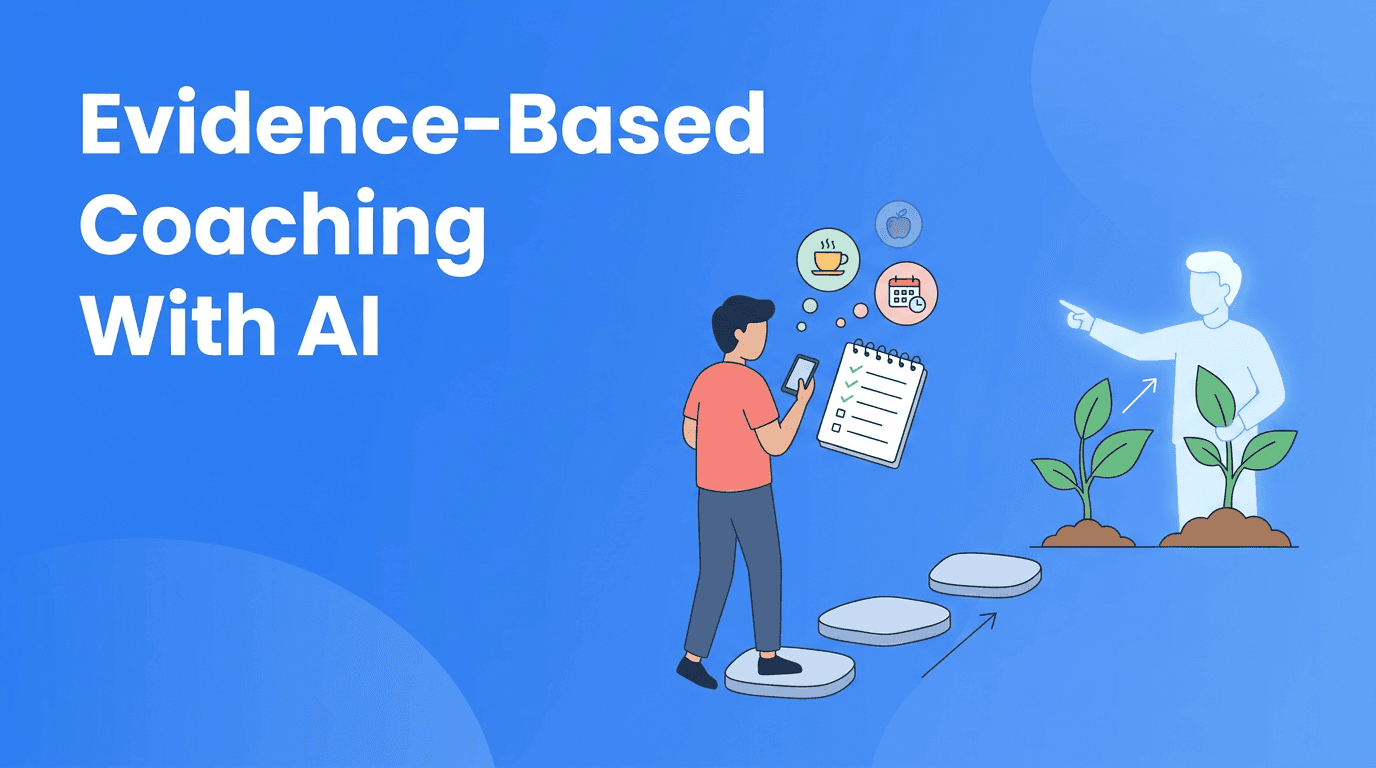
- Step 1: Define the target behavior. Focus on a concrete action, such as planning tomorrow in 5 minutes each evening.
- Step 2: Identify triggers and obstacles. Ask when the behavior should happen and what usually interrupts it.
- Step 3: Create a tiny experiment. Run the habit for one week with a clear cue and a realistic minimum version.
- Step 4: Track outcomes. Measure consistency, mood, effort, and barriers.
- Step 5: Adjust the system. Change the cue, timing, or difficulty based on actual results.
- Step 6: Reinforce identity. Link repeated action to a self-concept such as "I am someone who closes my day intentionally."
This is where AI can be unusually effective. It can remember context, prompt review, and maintain continuity across days. In many cases, the main barrier to growth is not lack of knowledge. It is lack of timely structure.
The future of coaching is likely hybrid
The future of coaching will probably not be a contest between humans and machines. A more plausible model is hybrid coaching, where human coaches provide depth, nuance, and relational complexity, while AI provides continuity, accessibility, and real-time reinforcement.
This matters because coaching often fails between sessions, not inside them. People leave with clarity, then return to overloaded calendars, emotional friction, and forgotten intentions. Technology can hold the thread. It can prompt the next step, track progress, and keep goals cognitively active.
- Human coaching is often strongest for complex identity work, emotional nuance, and major transitions.
- AI coaching is often strongest for frequent check-ins, structured reflection, and habit support.
- Together, they can create a more complete system for sustainable personal development.
What thoughtful users should watch for
Not every digital coaching tool deserves the label evidence-based coaching. Users should look for signs that an app or platform is grounded in credible behavioral principles rather than empty productivity theater.
- Does it encourage specific goals instead of vague ambition?
- Does it support reflection and review, not just reminders?
- Does it help you run small experiments and learn from results?
- Does it avoid perfectionist pressure and support sustainable behavior change?
- Does it personalize guidance based on your goals and actual patterns?
The best coaching technology should make you more observant, not more dependent. Its role is to strengthen self-awareness, decision quality, and follow-through.
Frequently Asked Questions
What is evidence-based coaching?
Evidence-based coaching uses insights from psychology and behavior science, combined with coaching practice and individual context, to support measurable personal growth.
How does AI help with behavior change?
AI helps with behavior change by providing timely prompts, personalized reflection, progress tracking, and consistent support between moments of insight and action.
Is coaching psychology the same as therapy?
No. Coaching psychology typically focuses on goals, strengths, performance, and self-regulation, while therapy often addresses mental health symptoms, distress, or clinical concerns.
Can an AI coaching app be effective for personal development?
Yes, especially for structure, habit support, and daily reflection. Apps like Haply can make coaching more accessible by turning proven principles into repeatable routines.