Evidence-Based Coaching Apps: How Behavioral Science Makes AI Support More Effective
Evidence-based coaching apps translate coaching psychology, behavior change, and positive psychology into daily action. Learn what makes them effective and how to use them wisely.

By Haply Team
Haply Editorial Team
Evidence-based coaching apps are becoming a serious topic in personal development because they do something simple but powerful: they translate coaching psychology, behavior change research, and positive psychology into repeatable daily actions. Instead of treating growth as vague inspiration, these tools structure reflection, planning, feedback, and accountability in ways that are easier to sustain.
This matters because many people do not fail from lack of ambition. They fail from lack of systems, timely prompts, and realistic follow-through. When designed well, technology-supported coaching can reduce friction, increase self-awareness, and help people practice the small behaviors that actually produce change over time.
Why evidence matters in digital coaching
The phrase evidence-based coaching should mean more than polished branding. In practice, it refers to methods informed by research from psychology, learning science, motivation theory, and habit formation. A useful app does not merely give advice. It helps users clarify goals, notice patterns, test strategies, and review outcomes.
- Coaching psychology contributes structured reflection, goal framing, and self-regulation tools.
- Behavior change research explains how cues, repetition, rewards, and environment shape action.
- Positive psychology adds strengths, meaning, optimism, and well-being practices that support sustainable growth.
- Evidence-based coaching integrates these ideas into interventions that can be observed, adjusted, and improved.
"What gets measured and reflected on is far more likely to change than what is merely hoped for."
The mechanism: how behavior change becomes practical
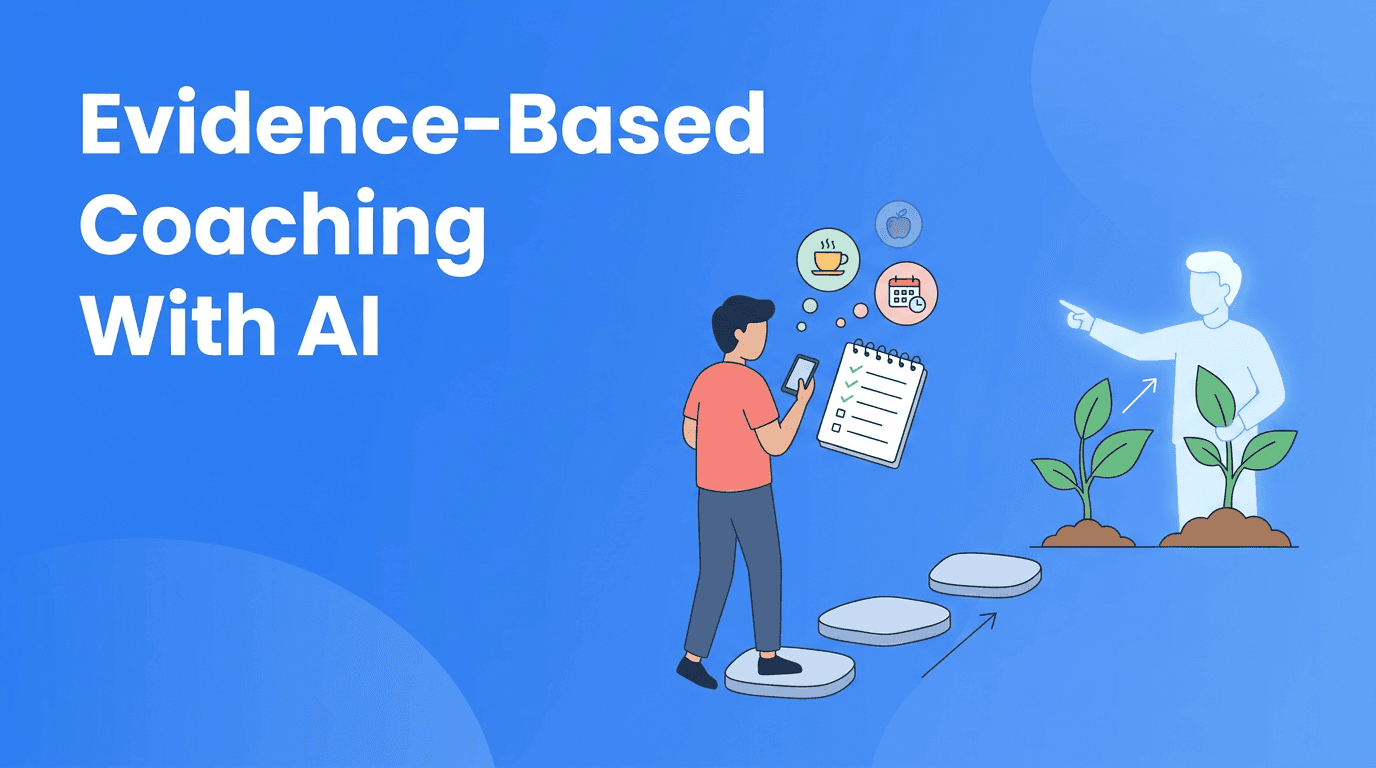
The strongest evidence-based coaching apps do not depend on motivation alone. They build a loop: define a target behavior, reduce ambiguity, prompt action at the right time, capture results, and create feedback. This is important because behavior is often shaped less by intention than by context.
From abstract goals to observable behaviors
A common coaching mistake is setting goals that sound impressive but are too broad to execute. "Improve my career" or "be healthier" are not behaviors. A science-informed system turns them into actions such as write for 20 minutes before email, walk after lunch, or review spending every Friday.
Why repetition beats intensity
Research on habit formation consistently suggests that consistency is usually more predictive than occasional heroic effort. Digital coaching works best when it supports small, repeatable actions. This is one reason chat-based coaching, reminders, streaks, and progress reviews can be effective when they are used thoughtfully rather than compulsively.
Try a science-informed coaching routine
Haply is an AI life coaching app for iOS and Android that combines chat-based guidance, habit tracking, daily reminders, and practical mini-tools for growth across productivity, wellness, career, learning, finance, creativity, and relationships.
Try Haply FreeWhat coaching psychology adds that generic advice does not
There is a meaningful difference between content and coaching. Content tells you what is generally useful. Coaching psychology helps you determine what is useful for you, under your constraints, with your motivations, and at your current stage of change. That distinction is where personalized technology becomes interesting.
- A coaching approach asks better questions, not just gives more tips.
- It emphasizes self-efficacy, the belief that you can influence your own outcomes.
- It supports metacognition, or thinking about how you think and act.
- It treats setbacks as data, not moral failure.
- It encourages experiments, review cycles, and adaptive planning.
An app like Haply can make this process more accessible by offering specialized AI coaches and a goal-based onboarding flow that personalizes the experience from the start. Instead of one-size-fits-all motivation, users can explore different life domains and build routines that fit real schedules.
Positive psychology without the fluff
Positive psychology is sometimes misunderstood as forced optimism. In a coaching context, it is more rigorous than that. It examines strengths, meaning, resilience, engagement, and well-being, then asks how these factors can support effective action. The useful question is not "How do I feel positive all the time?" but "What conditions help me function well and persist?"
This is where good digital tools can help. A Today Dashboard, motivational prompts, breathing exercises, sleep support, or reflection check-ins can improve the mental conditions that make disciplined action easier. Well-being is not separate from performance. It often underlies it.
A practical framework for choosing evidence-based coaching apps
If you are evaluating evidence-based coaching apps, look past surface design and ask whether the product supports real behavior change. The following checklist is a useful filter.
- Does it help you define specific behaviors, not just broad aspirations?
- Does it provide timely prompts or reminders linked to your actual routine?
- Does it track progress in a way that supports learning rather than guilt?
- Does it include reflection, review, or journaling to strengthen self-awareness?
- Does it adapt to multiple domains such as wellness, productivity, learning, or relationships?
- Does it reduce friction with practical tools like timers, planners, meditation, or budget tracking?
- Does it make coaching frequent and accessible enough to become part of daily life?
Haply is a useful example of this design logic. Beyond chat-based sessions, it includes a habit tracker with streaks and reminders, a Focus Timer, Task Planner, Meditation and Breathe tools, Sleep Stories, a Budget Tracker, and an Idea Board. Those features matter because behavior change is easier when insight and action live in the same system.
The future of coaching may be less dramatic and more useful
The future of coaching is often described in futuristic terms, but the most meaningful shift may be practical: coaching becomes more available, more frequent, and more integrated into ordinary decisions. Instead of waiting for a weekly session, people can reflect in the moment they are stuck, distracted, uncertain, or discouraged.
This does not eliminate human coaches. It changes the coaching ecosystem. Human coaching may become more strategic and deep, while AI-supported tools handle continuity, reminders, experimentation, and daily follow-through. For many people, that hybrid model could be more effective than either approach alone.
How to use behavior change technology intelligently
The best results usually come from disciplined use, not constant use. Try this simple sequence for one week.
- Choose one domain only, such as focus, sleep, learning, or spending.
- Define one tiny behavior you can perform in under 10 minutes.
- Attach it to a stable cue, such as after breakfast or before shutting your laptop.
- Use your coaching app for a brief daily check-in, not endless scrolling.
- Review at the end of the week: what worked, what failed, and what should change next?
This approach respects what evidence-based coaching actually implies: testable change, realistic scope, and iterative learning. Personal development becomes more scientific when it becomes more observable.
Frequently Asked Questions
What are evidence-based coaching apps?
Evidence-based coaching apps are digital coaching tools built around research from coaching psychology, behavior change, and positive psychology. They help users turn goals into structured, trackable actions.
Do evidence-based coaching apps actually help with behavior change?
They can, especially when they support clear goals, reminders, reflection, and progress tracking. Their value is strongest when users practice small behaviors consistently.
How is coaching psychology different from self-help advice?
Coaching psychology focuses on personalized reflection, self-regulation, and goal-directed change rather than generic tips. It helps people apply insight to their own context.
Can an AI life coaching app replace a human coach?
Not completely for every situation. AI tools are often most useful for daily support, accountability, and habit practice, while human coaches may be better for deeper complexity and nuance.
What should I look for in a science-backed coaching app?
Look for behavior-specific planning, reminders, progress tracking, reflection tools, and support across real life domains. The best apps make action easier, not just motivation louder.