Online coaching platforms: how to choose between AI support and traditional life coaching
Online coaching platforms now range from AI support tools to traditional life coaching services. This guide helps you compare options, costs, access, and fit before you commit.

By Haply Team
Haply Editorial Team
Online coaching has expanded far beyond weekly video calls. Today, people choosing support for personal growth can pick from traditional life coaching, app-based guidance, hybrid programs, and AI-powered tools. That variety is useful, but it also makes the decision harder. Instead of asking which format is best in general, a better question is: which type of support fits your goals, routines, budget, and need for accountability?
Why online coaching feels harder to choose now
A few years ago, online coaching usually meant working with a person over Zoom. Now the category includes chat-based coaching, asynchronous messaging, guided reflections, progress dashboards, habit tools, and personalized prompts. This wider market has created a more realistic coaching comparison: not just human versus digital, but high-touch versus flexible, premium versus affordable, and scheduled versus on-demand.
- Choose traditional life coaching if you want deep conversation, live nuance, and real-time interpersonal feedback.
- Choose an AI-supported option if you want frequent check-ins, lower cost, and support between busy moments.
- Choose a hybrid model if you want a human relationship plus structured digital accountability tools.
- Choose self-guided online coaching platforms if you already have motivation and mainly need systems, prompts, and tracking.
A practical coaching comparison: what you are really buying
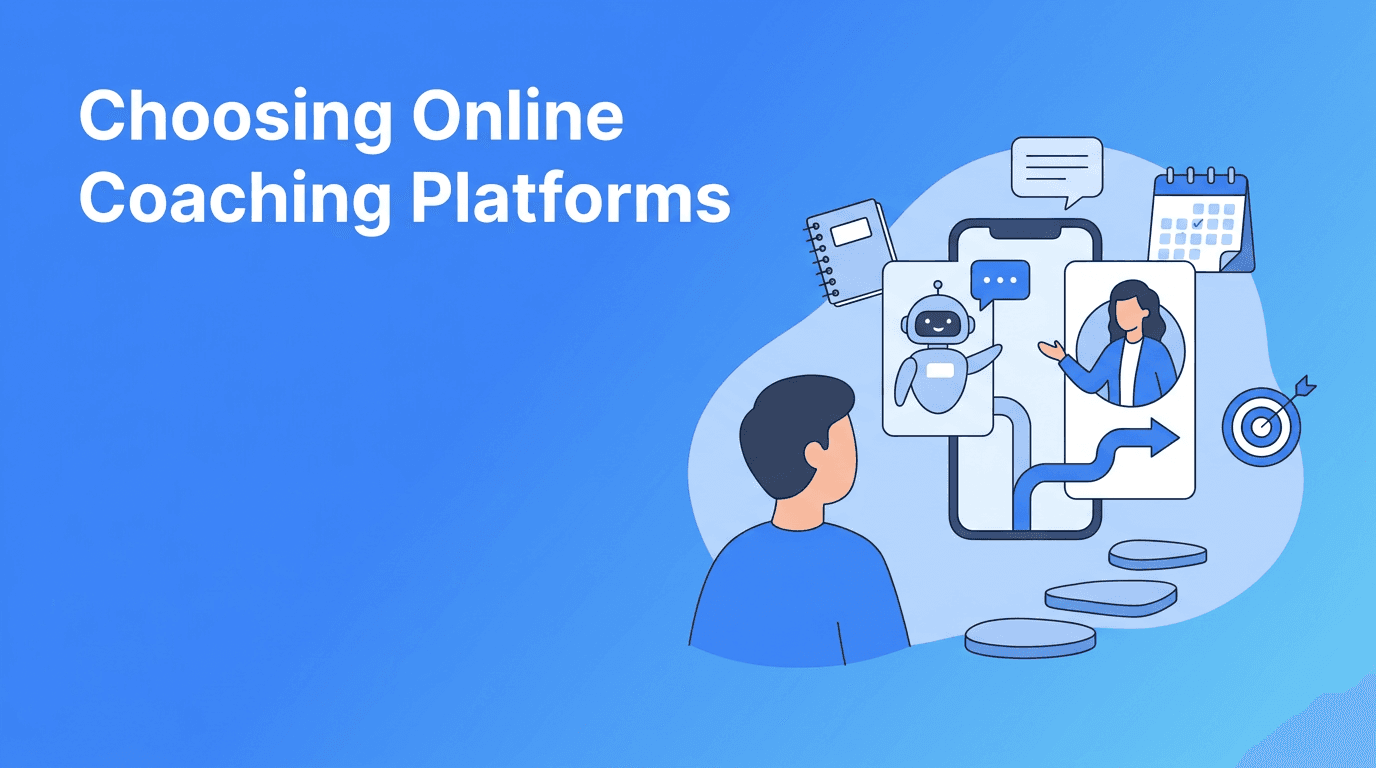
When people search for AI vs human coach, they often focus on personality or trust. But the real purchase decision usually comes down to five things: access, cost, consistency, customization, and emotional depth. Looking at those factors gives a more useful coaching comparison than broad claims about what coaching should be.
1. Access and response time
Human coaches are limited by calendars. That can be valuable because scheduled sessions create commitment, but it also means support may arrive only once a week. AI-based online coaching tools are available whenever a challenge appears, whether that is before a difficult meeting, during a motivation dip, or at the end of a stressful day.
2. Cost and scalability
Traditional life coaching can be highly personalized, but it is often expensive. AI tools scale differently, which lowers the entry barrier for people who would never purchase private coaching. This is one of the biggest shifts in technology-powered personal development: more people can now access structured support without a premium price tag.
3. Consistency between sessions
Growth rarely happens in a single breakthrough conversation. It comes from repeated reflection and action. Many online coaching platforms do well here because they provide nudges, trackers, and reminders. For example, Haply is an AI life coaching app on iOS and Android that combines chat-based coaching with a habit tracker, daily reminders, and mini-tools like a Focus Timer, Task Planner, Meditation/Breathe, Sleep Stories, Budget Tracker, and Idea Board. That kind of system helps users stay engaged between insights.
"The best coaching support is not always the most impressive session. It is the system that helps you return to your goals when real life interrupts."
AI vs human coach: where each option is strongest
An honest AI vs human coach discussion should avoid extremes. AI is not a replacement for every coaching need, and human coaching is not automatically the best fit for every person. Each option has strengths that matter in different situations.
- A human coach is often strongest when you need relational nuance, live challenge, and a deeper sense of being witnessed.
- An AI coach app is often strongest when you need immediate support, repetition, structured reflection, and practical follow-through.
- A human coach may be better for complex identity questions, emotionally charged decisions, or high-stakes transitions.
- AI-supported online coaching may be better for habit building, daily accountability, and low-friction self-reflection.
- For many people, the smartest choice is not AI or human, but the right sequence, starting with one and adding the other later if needed.
Who benefits most from AI-supported life coaching
AI-supported life coaching is especially useful for people whose biggest barrier is not insight, but consistency. If you already know what you should do but struggle to do it regularly, technology can add the missing layer: prompts at the right time, simple planning tools, and a place to process setbacks without waiting for an appointment.
- Busy professionals who need coaching in short windows during the day
- Beginners who want affordable guidance before investing in premium coaching
- People building habits in productivity, wellness, career, learning, finance, creativity, or relationships
- Users who prefer writing thoughts in chat rather than speaking live on calls
- Anyone who wants a daily dashboard, reminders, and measurable progress rather than occasional inspiration
Want a simple way to test AI-supported coaching?
Haply offers chat-based personalized coaching, goal-based onboarding, daily guidance, streaks, achievements, and practical mini-apps that turn insight into action.
Try Haply FreeHow to evaluate online coaching platforms before you commit
If you are comparing providers, avoid judging based on branding alone. The best online coaching option is the one you will actually use. Before signing up, look for evidence that the platform supports both reflection and execution.
- Check whether the service helps you define specific goals, not just vague self-improvement intentions.
- Look for personalization, such as onboarding questions, tailored prompts, or adaptive recommendations.
- Review the accountability features, including reminders, streaks, planner tools, or follow-up check-ins.
- Ask how the platform handles different life areas like career, wellness, relationships, and focus.
- Consider whether the format matches your energy: live calls, messaging, AI chat, or a blended experience.
- Test the user experience. If opening the app feels like work, long-term use is less likely.
A better decision framework than 'best coach'
Rather than searching for the single best service, score your options across three dimensions: depth, frequency, and friction. Depth means how meaningful the support feels. Frequency means how often you can realistically access it. Friction means how easy it is to start using when you need help. Many people discover that high-frequency, low-friction support creates better real-world results than low-frequency support that looks impressive on paper.
The future of coaching is likely layered, not one-size-fits-all
The future of personal development will probably not be a simple win for either traditional life coaching or AI. More likely, coaching will become layered. People may use AI for daily reflection, planning, and momentum, then bring key patterns into occasional human sessions. In that model, technology does not reduce coaching quality. It can make coaching more continuous, more accessible, and more integrated into everyday life.
That is why the most useful coaching comparison is not old versus new. It is whether a tool helps you notice patterns, make decisions, and follow through. If a platform can do that consistently, it deserves serious consideration.
Frequently Asked Questions
What is online coaching and how does it work?
Online coaching is personal or professional coaching delivered through digital channels like video calls, chat, apps, or messaging. It helps people work on goals, habits, decisions, and accountability remotely.
Is AI coaching better than human coaching?
It depends on your needs. AI coaching is often better for daily access, affordability, and habit support, while human coaching is often better for deeper relational nuance and complex conversations.
Can online coaching help with life coaching goals?
Yes. Online coaching can support common life coaching goals such as productivity, confidence, wellness, career planning, and relationship habits, especially when it includes reminders and progress tracking.
How do I choose between online coaching platforms?
Compare them by goal fit, personalization, accountability tools, ease of use, and pricing. The best platform is the one that matches your routine and keeps you engaged consistently.