Attention Residue: The Hidden Productivity Leak That Ruins Focus
Attention residue quietly undermines productivity, focus, and time management whenever you switch tasks too fast. Learn how to reduce it and get more meaningful work done.

By Haply Team
Haply Editorial Team
Attention residue is one of the most overlooked reasons smart people struggle with productivity, focus, and getting things done. You may be using solid time management methods, but if your mind is still stuck on the last task, your efficiency drops before the next one even begins.
Why attention residue hurts productivity more than you think
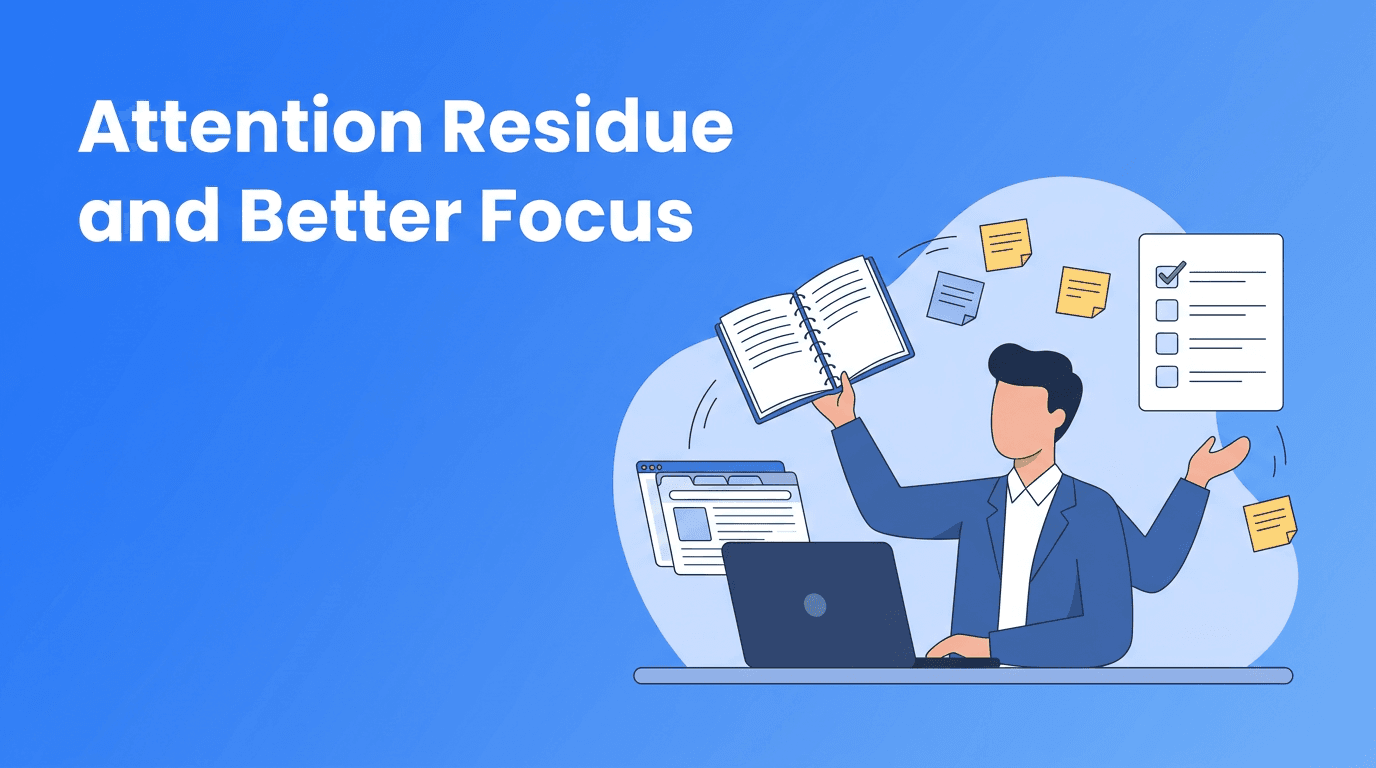
The idea is simple. When you move from one task to another, part of your attention often stays behind. That leftover mental drag is called attention residue. It makes it harder to think clearly, start quickly, and do high-quality work. Even short interruptions can leave a cognitive trail that slows you down.
- You finish half an email, jump into a meeting, and keep thinking about the email.
- You start a report, check messages for two minutes, and lose your train of thought.
- You switch between study topics and need extra time to re-enter the material each time.
Productivity is not just about managing time. It is about protecting attention.
The real cost of task switching on focus and efficiency
Many professionals assume they are good at multitasking. In reality, most knowledge work depends on sustained concentration. Every unnecessary switch creates friction. That friction shows up as slower thinking, more mistakes, shallow work, and a constant sense of being busy without making meaningful progress.
How it affects getting things done
- Longer start-up time - each new task requires mental reorientation.
- Lower quality output - important details are easier to miss when your brain is split.
- More stress - unfinished tasks stay mentally active and create background tension.
- Weaker prioritization - reactive switching can replace intentional time management.
This is why a full calendar does not always equal real output. If your day is fragmented, your productivity may look active on the surface while your best thinking gets diluted underneath.
How to reduce attention residue in a practical way
1. Finish with a reset note
Before leaving a task, write one sentence about the next step. This creates a clean re-entry point later. Instead of returning confused, you return with momentum. A simple note like 'Next: outline section two and verify the data source' can save several minutes.
2. Group similar cognitive work
Try to keep similar tasks together so your brain does not have to constantly change modes. Writing, planning, admin, and communication each require different kinds of attention. Grouping them improves efficiency and reduces mental drag.
3. Protect your first deep-work window
Your best focus often happens early, before messages and requests start pulling at your attention. Use that window for your most mentally demanding task, not for low-value maintenance work.
4. Use friction against distractions
Turn off nonessential notifications, close extra tabs, and keep your phone out of reach during concentrated work. Good time management is often less about planning more and more about removing easy exits from effort.
Build a focus system that actually sticks
Haply helps you turn productivity advice into daily action with AI coaching, a Focus Timer, Task Planner, habit tracking, and personalized reminders on iOS and Android.
Try Haply FreeA simple daily workflow to beat attention residue
- Pick one primary outcome for the day before opening inboxes or chats.
- Work on that priority in a 30- to 60-minute focus session.
- When you stop, leave a short reset note for your future self.
- Batch communication into planned windows instead of constant checking.
- End the day by listing unfinished tasks and the next action for each.
This workflow is especially useful for remote workers, students, and anyone doing creative or analytical work. It supports better productivity without requiring a complicated system.
Where Haply fits into your productivity routine
If you want more consistency, Haply can help you apply these ideas in real life. Its AI productivity coaches offer chat-based support, the Today Dashboard keeps your day visible, and tools like the Focus Timer and Task Planner make it easier to protect attention instead of constantly reacting. For people trying to improve focus and getting things done, that structure can be the difference between good intentions and repeatable action.
Final thought: Better attention creates better time management
If your current system feels organized but you still struggle to make progress, look beyond your calendar. Attention residue may be quietly draining your efficiency. Reduce unnecessary task switching, create stronger transitions, and protect your best mental hours. Often, the fastest route to better productivity is not doing more. It is carrying less mental residue into what matters next.
Frequently Asked Questions
What is attention residue in productivity?
Attention residue is the leftover mental attention that stays on a previous task after you switch to a new one. It reduces focus and makes deep work harder.
How do I reduce attention residue at work?
Use fewer task switches, leave a note before stopping a task, batch similar work, and limit notifications during focus sessions.
Does multitasking reduce efficiency?
Yes. For most knowledge work, multitasking lowers efficiency because your brain must repeatedly reorient, which slows thinking and increases mistakes.
What is the best time management method for better focus?
The best method is one that protects uninterrupted work time. Simple focus blocks, clear priorities, and planned communication windows work well for many people.