Time Blocking for Overthinkers: A Calmer Way to Beat Procrastination
If your to-do list makes you freeze, time blocking can turn vague plans into clear action. Learn a calmer system to reduce procrastination, protect deep work, and build motivation without burnout.

By Haply Team
Haply Editorial Team
If your brain treats a long task list like a threat, time blocking can help. Instead of deciding what to do every few minutes, you assign work to specific windows in advance. This simple shift reduces procrastination, supports deep work, and makes time management feel less like a daily battle.
Why overthinkers struggle with productivity
A lot of productivity advice assumes your problem is laziness. Usually, it is not. Many overwhelmed people get stuck because they have too many open loops, too many choices, and no clear starting point. That creates friction, and friction kills motivation.
- You keep rewriting your to-do list instead of starting
- You wait until you 'feel ready' to do important work
- You confuse planning with progress
- You jump between tasks and lose momentum
- You end the day busy, but not satisfied
You do not need more willpower. You need fewer decisions between you and the task.
What time blocking actually does
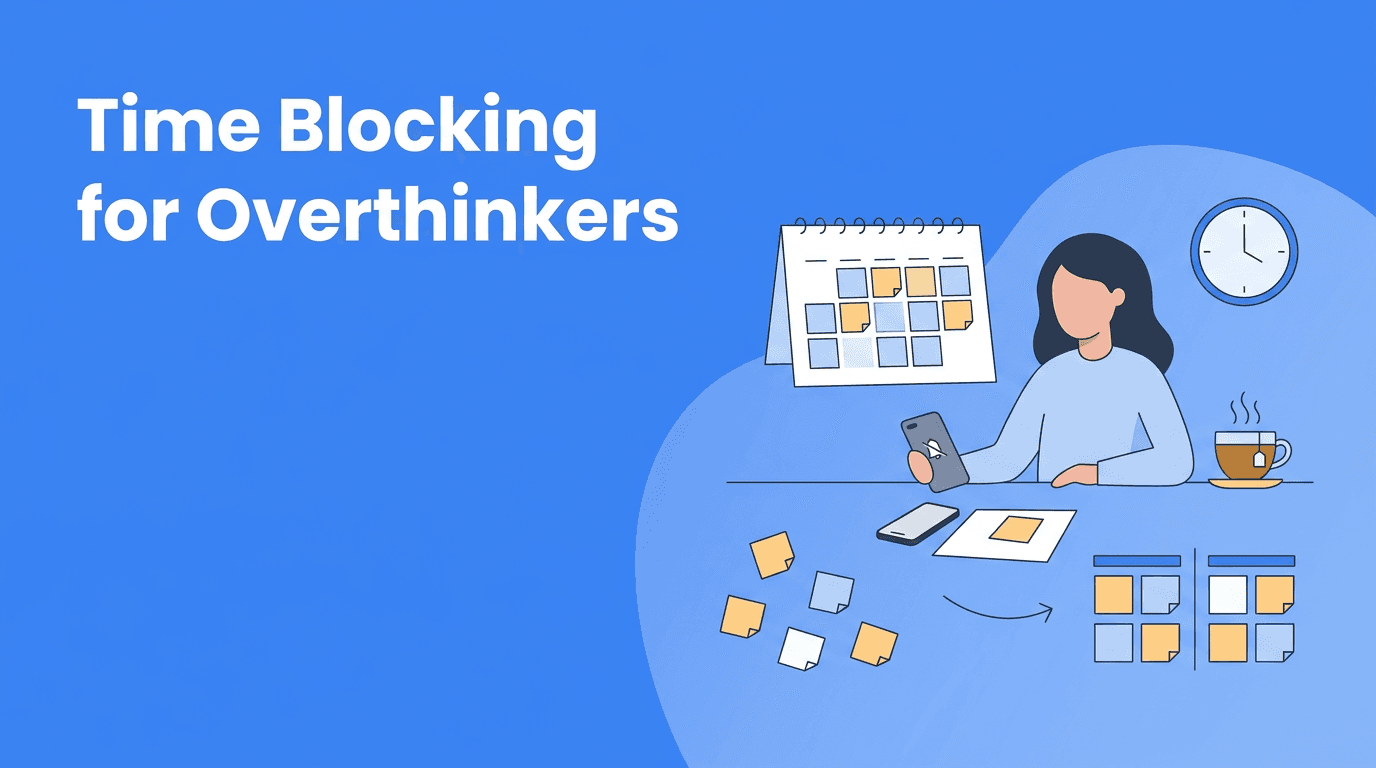
Time blocking gives each task a home on your calendar. That matters because your brain stops asking, 'What should I do now?' and starts following a visible plan. It is one of the most practical productivity tips for people who feel mentally crowded.
It turns vague goals into visible action
'Work on project' is vague. 'Draft slide outline from 10:00 to 10:45' is actionable. The more specific your block, the easier it is to begin.
It protects deep work
When you reserve uninterrupted blocks for meaningful tasks, you make room for deep work instead of giving your best hours to messages, meetings, and small admin tasks.
It lowers procrastination triggers
Many people procrastinate because the task feels huge or undefined. A short block, such as 25 or 45 minutes, shrinks the emotional weight of the work. You are not promising to finish everything. You are just showing up for the block.
A simple time blocking system that actually works
- Step 1: Pick your top 3 priorities. If everything is important, nothing is. Choose the tasks that would make the day feel meaningful.
- Step 2: Match tasks to energy. Put creative or analytical work in your strongest hours. Save easier tasks for low-energy periods.
- Step 3: Use small blocks. Start with 30 to 60 minutes. Shorter blocks feel safer and reduce resistance.
- Step 4: Add buffer space. Leave gaps between blocks for breaks, spillover, or surprise tasks.
- Step 5: End with a shutdown block. Spend 10 minutes reviewing what moved, what did not, and what tomorrow needs.
This is where time management gets more realistic. The goal is not to schedule every minute perfectly. The goal is to create a structure that is kind enough to follow.
Want help turning plans into action?
Haply is an AI life coaching app for iOS and Android that can help you build a realistic planning routine. Use chat-based Productivity coaching, the Task Planner, and the Focus Timer to make time blocking easier to stick with.
Try Haply FreeCommon time blocking mistakes
- Overpacking the day. Most people plan for an ideal version of themselves. Plan for your real energy, not your fantasy energy.
- Ignoring transition time. It takes time to switch contexts, gather materials, and reset your attention.
- Making every block high stakes. Not every session needs peak performance. Some blocks are for progress, not brilliance.
- Skipping breaks. Breaks protect focus. Without them, your later blocks become performative, not productive.
- Treating the schedule like a test. If a block fails, adjust the system. Do not turn it into evidence that you are bad at productivity.
How to keep motivation when the plan slips
Even good systems break sometimes. Meetings run long. Energy drops. Life happens. The key is not to restart next Monday. Use a simple rule: if a block gets missed, move it, shrink it, or delete it on purpose. That keeps you in control and protects motivation.
- Move it if it is still important and you have real space later
- Shrink it if starting matters more than finishing
- Delete it if it was never essential in the first place
This mindset helps with procrastination too. Missed blocks are data, not drama. They show you where your plan was too ambitious, too vague, or poorly timed.
Make time blocking easier with digital support
If you struggle to plan alone, tools can reduce the friction. In Haply, you can check your Today Dashboard, map your day in the Task Planner, and run a session with the Focus Timer when it is time for deep work. The app also includes daily reminders, streaks, and AI coaches that help you troubleshoot your routine when your schedule starts slipping.
The goal is not a perfect calendar
The best productivity tips are the ones that reduce stress, not just increase output. Time blocking works because it replaces constant decision-making with gentle structure. If you tend to overthink, that structure can be the difference between staring at your list and actually starting.
Frequently Asked Questions
What is time blocking and how does it help productivity?
Time blocking is a planning method where you assign tasks to specific time slots on your calendar. It improves productivity by reducing decision fatigue and creating clear start times.
Is time blocking good for procrastination?
Yes. Time blocking makes tasks feel smaller and more defined, which lowers the resistance that often causes procrastination.
How many hours should I time block each day?
Start by blocking your most important 2 to 4 hours, not your entire day. This makes the system easier to maintain and protects space for deep work.
What is the difference between time blocking and a to-do list?
A to-do list tells you what matters, but time blocking tells you when to do it. Combining both usually works better than using either one alone.