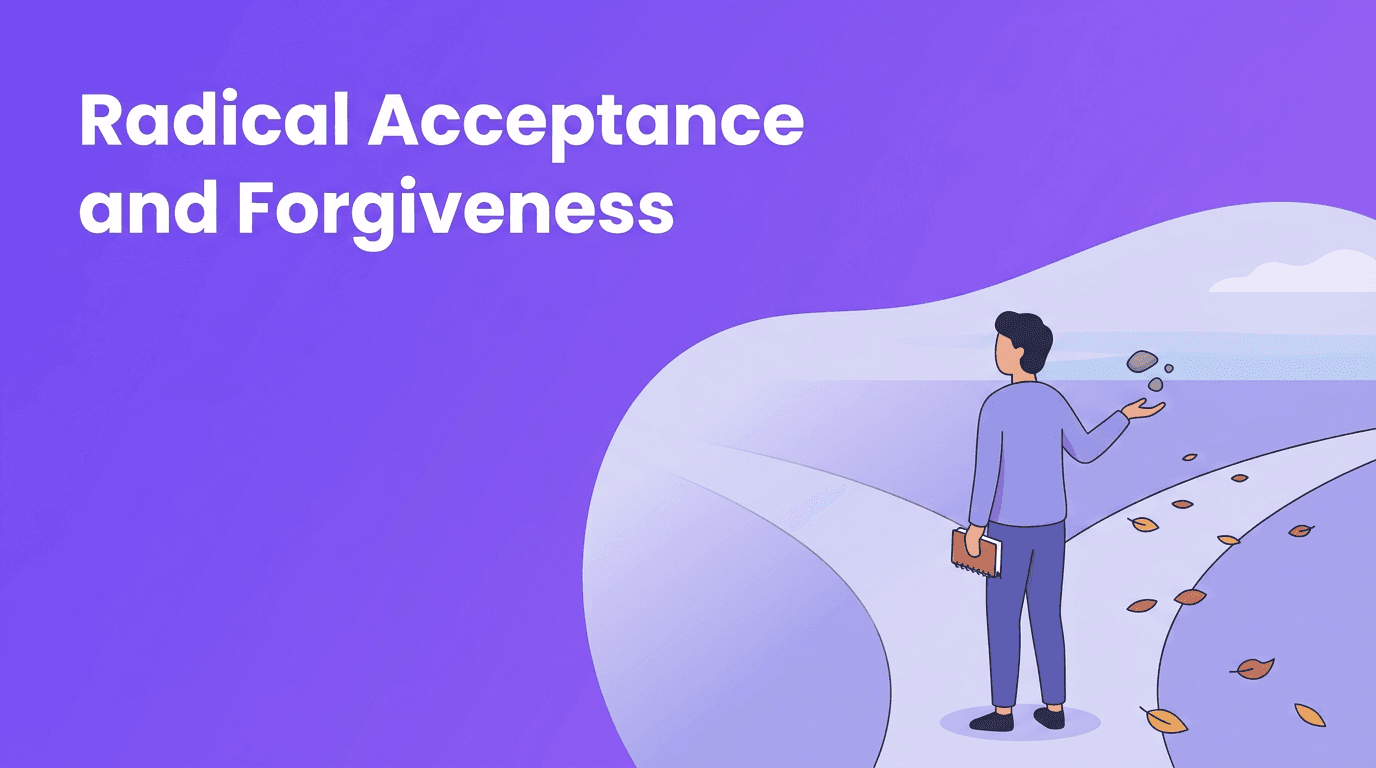
Acceptance Journaling: A Quiet Practice for Uncertainty and Inner Peace
Acceptance journaling is a reflective practice that helps you meet uncertainty with honesty, soften the grip of letting go, and grow inner peace through forgiveness and philosophy.


By Haply Team
Haply Editorial Team
Some days do not ask for solutions. They ask for presence. Acceptance journaling is a simple but profound practice for moments when life feels unfinished, uncertain, or emotionally tangled. Instead of forcing clarity, it teaches you to sit beside your experience with honesty. In that quiet space, letting go, forgiveness, and inner peace stop being abstract ideals and become lived possibilities.
Why acceptance journaling matters in uncertain seasons
We often imagine peace as the reward for finally controlling life. But a deeper philosophy suggests something else: peace begins when we stop demanding certainty from a world that cannot promise it. Acceptance journaling offers a way to practice this truth on paper. You write not to fix every feeling, but to witness it without immediate resistance.
"Peace comes not from rearranging reality, but from meeting it without war inside yourself."
This is not passive resignation. Acceptance is an active stance. It says, "This is what is here, and I will begin here." That beginning matters. It softens panic, reduces internal conflict, and creates room for wiser action.
What acceptance journaling is, and what it is not
It is a practice of honest observation
At its core, acceptance journaling means describing your inner and outer reality with as little distortion as possible. You name what happened, what you feel, what you fear, and what you cannot yet resolve. This is mindfulness in written form.
It is not giving up
Many people confuse acceptance with surrendering agency. But the opposite is often true. When you stop arguing with facts, your energy returns. You can choose your next step more clearly. Uncertainty becomes less of a threat and more of a condition you know how to live with.
- Write the facts first: What happened, without interpretation?
- Name the feeling second: What emotions are present right now?
- Notice the resistance: What are you wishing were different?
- Ask the wise question: What is still within your care today?
A 10-minute acceptance journaling ritual
If you are new to the practice, keep it small. The goal is not brilliance. The goal is truthfulness.
- Minute 1-2: Sit quietly and take five slow breaths. Let your shoulders drop.
- Minute 3-4: Write one sentence that begins with "Right now, the truth is..."
- Minute 5-6: Complete the sentence "What I am resisting is..."
- Minute 7-8: Complete the sentence "What I can allow, even if I do not like it, is..."
- Minute 9: Write one line of forgiveness, either toward yourself, another person, or life itself.
- Minute 10: End with "The next kind thing I can do is..."
Repeated over time, this ritual trains your mind to move from reaction to reflection. Acceptance journaling becomes a bridge between emotional overwhelm and grounded action.
Journal prompts for letting go and forgiveness
When the mind loops, prompts can open a door. Use these slowly. Choose one, not all.
- What am I still trying to control that is no longer mine to carry?
- If I stopped demanding a different past, what feeling would surface first?
- What would letting go protect in me, rather than take from me?
- Where do I need forgiveness more than self-punishment?
- What uncertainty am I secretly turning into catastrophe?
- What would acceptance look like for the next 24 hours only?
The philosophy behind the page
From Stoic thought to Buddhist insight, many traditions agree on one difficult lesson: suffering grows when we cling to what changes by nature. This does not mean we should feel less. It means we can relate to feeling differently. Philosophy becomes practical when it teaches us how to meet ordinary heartbreak, ambiguity, and disappointment.
In this sense, acceptance journaling is not just a wellness habit. It is a small existential practice. It helps you ask: What is real? What is mine to do? What must be grieved? What can be released? These are not easy questions, but they are liberating ones.
Want support beyond the page?
Haply is an AI life coaching app for iOS and Android that can help you build a reflective routine through chat-based coaching, Wellness support, daily reminders, and the Meditation/Breathe mini-app. If you want help turning insight into habits, it offers a gentle place to begin.
Try Haply FreeHow to stay with the practice when emotions rise
Keep your writing concrete
When feelings intensify, abstraction can make them bigger. Write about this conversation, this loss, this fear, this hour. Precision often creates calm.
Use compassion, not performance
Your journal is not a courtroom. It is not there to prove that you are wise, healed, or spiritually advanced. It is there to help you tell the truth kindly. That is often enough for inner peace to begin.
Pair journaling with breath
If writing opens strong emotion, pause for one minute of slow breathing. Tools like Haply's Meditation/Breathe mini-app can make this easier, especially when you want a guided reset after reflective writing.
A final thought on uncertainty
We do not become peaceful because life becomes fully explainable. We become peaceful, sometimes, because we learn how to remain present without total answers. Acceptance journaling will not erase grief, solve every relationship, or remove the ache of change. But it can help you become more spacious than your fear. And sometimes that spaciousness is the beginning of freedom.
Frequently Asked Questions
What is acceptance journaling?
Acceptance journaling is a reflective writing practice that helps you acknowledge reality, process emotions, and respond to uncertainty with more clarity and calm.
How does acceptance journaling help with uncertainty?
It reduces inner conflict by helping you name what is happening, what you feel, and what is still within your control. This makes uncertainty feel more workable.
Can journaling help with letting go and forgiveness?
Yes. Journaling creates space to express pain honestly, recognize resistance, and practice new perspectives that support letting go and forgiveness over time.
How often should I practice acceptance journaling?
Start with 10 minutes, three to five times a week. Consistency matters more than length.
Is acceptance the same as giving up?
No. Acceptance means seeing reality clearly so you can respond wisely. Giving up removes agency, while acceptance helps restore it.