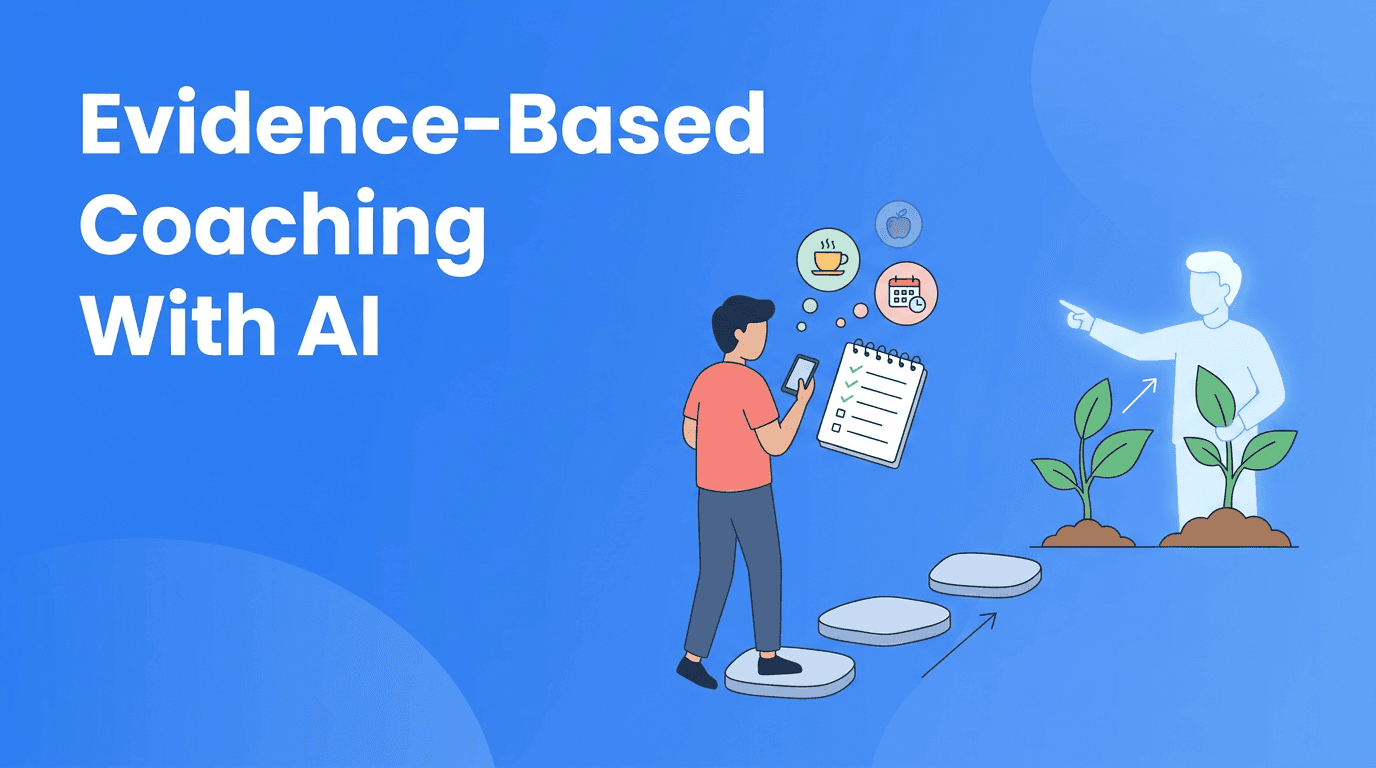
Behavior Change Loops: How Technology-Powered Coaching Makes Growth Stick
Behavior change is easier when feedback, reflection, and action happen in tight loops. Learn how technology-powered coaching turns personal development into a practical, measurable system.

By Haply Team
Haply Editorial Team
Behavior change rarely fails because people lack ambition. More often, it fails because insight and action are too far apart. When reflection happens on Sunday, motivation fades by Tuesday, and feedback arrives weeks later, the brain loses the conditions that support adjustment. Technology-powered coaching changes that timing. It creates shorter loops between intention, action, and review, which makes personal development more testable and more likely to last.
Why behavior change depends on loops, not inspiration
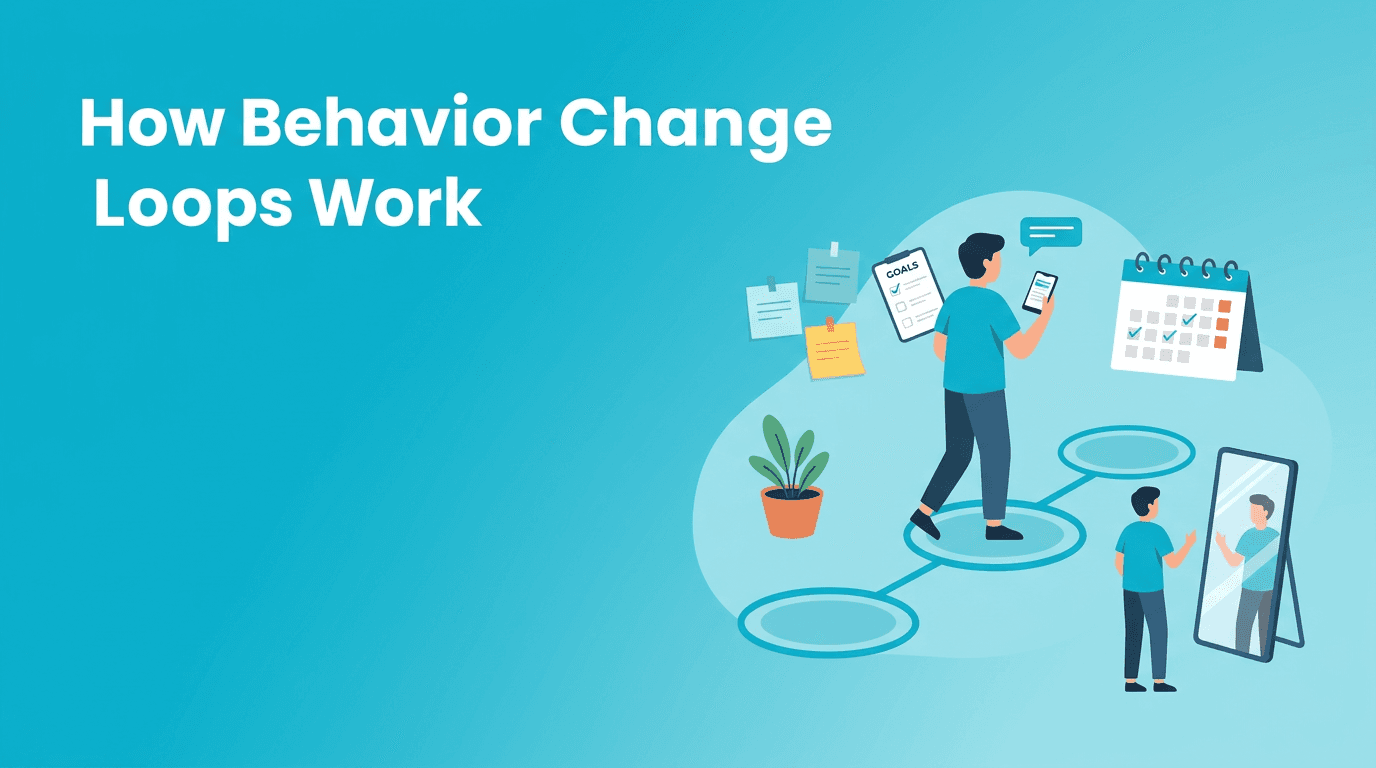
A useful way to think about growth is as a series of loops: notice a pattern, choose an intervention, act, review the outcome, and refine the next step. This is where coaching psychology becomes especially relevant. Good coaching does not just offer encouragement. It helps people generate better observations, ask sharper questions, and translate abstract goals into experiments they can actually run in daily life.
- Observation: What happened, and in what context?
- Interpretation: What belief, emotion, or trigger shaped the response?
- Experiment: What is one small adjustment worth testing next?
- Feedback: What changed after the adjustment?
- Iteration: What should be repeated, simplified, or dropped?
"Sustainable growth is usually less about dramatic reinvention and more about improving the quality of your feedback loops."
What science says about behavior change and coaching
Research across behavior change, self-regulation, and habit formation consistently points to a few principles. People do better when goals are specific, progress is visible, friction is low, and reflection is timely. This overlaps with ideas from positive psychology, which emphasizes strengths, meaning, optimism, and conditions that support human flourishing. Importantly, none of this requires blind positivity. The point is not to think happy thoughts and hope for the best. The point is to design environments and routines that make effective action easier.
From insight to implementation
Many people understand what they should do, yet still struggle to do it consistently. That gap is where evidence-based coaching becomes useful. Evidence-based methods draw from psychological research, structured reflection, and measurable goal-setting. In practice, that means replacing vague ambitions like "be more productive" with operational questions such as: What specific task tends to stall? At what time? After which cue? What is the smallest version of the task I can complete today?
- Use implementation intentions: "If X happens, I will do Y."
- Track leading indicators, not just outcomes. For example, count study sessions, not only grades.
- Reduce activation energy by preparing the first step in advance.
- Review patterns weekly so goals evolve with real data, not self-criticism.
Why technology-powered coaching can outperform memory alone
Human memory is selective, emotional, and often distorted by recency. We remember the dramatic failure and forget the six quiet wins. We overestimate consistency when motivation is high and underestimate progress when mood is low. A coaching system supported by technology can counter those distortions. It can prompt reflection at the right moment, capture data before it disappears, and surface patterns that are hard to see from the inside.
This is one reason chat-based coaching tools are becoming more compelling for analytically-minded users. Instead of waiting for a weekly session, they can think through a challenge in real time, log what happened, and convert a vague problem into a concrete next move. In Haply, for example, users can combine personalized chat-based support with a habit tracker, reminders, and mini-tools like a Focus Timer or Task Planner. That makes the coaching loop tighter: think, act, review, adjust.
Want a smarter way to build momentum?
Haply helps you turn reflection into action with personalized coaching chats, habit tracking, and daily tools that support real behavior change across work, wellness, learning, and more.
Try Haply FreeA practical model for designing better behavior change experiments
If you want technology-powered personal development to be useful, treat it like a lab for self-observation rather than a source of generic motivation. The goal is to run small, informed experiments. Each experiment should be simple enough to complete, clear enough to evaluate, and meaningful enough to repeat if it works.
The 5-part experiment template
- Define the target behavior in observable terms. Not "read more," but "read 10 pages after dinner."
- Identify the cue that should trigger the behavior.
- Choose the minimum viable action so resistance stays low.
- Decide how you will record completion immediately.
- Set a review point to assess what helped or blocked follow-through.
This approach is especially helpful when a goal feels emotionally loaded. A small experiment creates psychological distance. Instead of asking, "Why am I so undisciplined?" you ask, "What variable should I change next?" That shift is subtle but powerful, and it reflects the more rigorous side of coaching psychology.
Where positive psychology fits, and where it is misunderstood
Positive psychology is sometimes reduced to slogans about gratitude or confidence. That is a shallow reading. In a stronger sense, positive psychology studies the conditions that help people function well: engagement, resilience, strengths, supportive relationships, meaning, and accomplishment. In coaching, this matters because sustainable growth is easier when goals align with values and strengths, not just external pressure.
For example, if someone repeatedly fails at a morning routine, the issue may not be laziness. The routine may conflict with their energy profile, work demands, or motivational style. A strengths-aware coach, human or digital, would not simply push harder. It would help redesign the routine so it fits the person better.
How to evaluate whether a coaching tool is evidence-based
- Does it help you define goals in specific, measurable terms?
- Does it encourage reflection tied to actual behavior, not just mood?
- Does it support iteration, so strategies can be refined over time?
- Does it make progress visible, through streaks, logs, or summaries?
- Does it adapt to different domains such as productivity, wellness, career, or relationships?
These questions matter because the future of personal development will likely belong to systems that combine convenience with rigor. The best tools will not just deliver advice. They will scaffold attention, support experimentation, and help users learn from their own data. That is the practical promise of evidence-based coaching in a digital format.
Final thought: coaching becomes more useful when it becomes easier to test
The future of coaching may be less about grand speeches and more about better systems for noticing, deciding, and repeating. Behavior change improves when support is immediate, reflection is structured, and progress is visible. Technology does not replace human depth in every context, but it can make the mechanics of growth far more accessible. For many people, that is exactly what turns self-improvement from an aspiration into a practice.
Frequently Asked Questions
What is behavior change in coaching?
Behavior change in coaching is the process of identifying patterns, testing new actions, and reinforcing habits that support a goal. It focuses on observable actions rather than vague intentions.
How does coaching psychology support behavior change?
Coaching psychology uses structured reflection, goal-setting, and behavior science to help people translate insight into action. It aims to improve self-awareness and practical follow-through.
What makes evidence-based coaching different?
Evidence-based coaching draws on research from psychology and behavior science, then applies those findings through measurable, adaptable coaching methods. It emphasizes testing and review rather than generic advice.
How is positive psychology used in coaching?
Positive psychology in coaching helps people build on strengths, meaning, resilience, and motivation. It supports growth by aligning goals with what makes functioning sustainable and fulfilling.