Best Productivity Apps for People Who Want One System, Not 12 Separate Tools
Looking for the best productivity apps without juggling a dozen downloads? This guide compares all-in-one and specialized tools, including habit tracker apps, meditation apps, AI apps, and reading apps for real daily progress.
By Haply Team
Haply Editorial Team
If you are searching for the best productivity apps, there is a good chance you do not need more tools, you need a better system. The real challenge is not finding an app with one nice feature. It is choosing digital tools that work together for planning, focus, habits, learning, and recovery without turning your phone into a second job.
This guide takes a practical angle: instead of listing random favorites, it shows how to choose apps by the role they play in your day. We will compare habit tracker apps, meditation apps, AI apps, and reading apps so you can build a setup that supports personal improvement with less friction.
Why most app stacks fail
Many people download one app for tasks, another for journaling, another for focus, and three more for wellness. A week later, notifications pile up, data lives in separate places, and motivation drops. The better approach is to start with your daily bottleneck: planning, consistency, stress, or learning.
- If you forget priorities, choose a strong planning app first.
- If you struggle to stay consistent, look at habit tracker apps.
- If stress kills your focus, add one of the better meditation apps.
- If you want guidance, explore AI apps that personalize coaching or workflows.
- If you want to learn daily, keep a short list of useful reading apps.
The four app roles that actually improve your day
1. Planning and execution
This is where the best productivity apps earn their place. You need a tool that helps you decide what matters today, not just store endless tasks. Apps like Todoist, TickTick, and Notion can work well here, depending on whether you prefer simple checklists, calendar-aware planning, or flexible workspaces.
2. Consistency and habit building
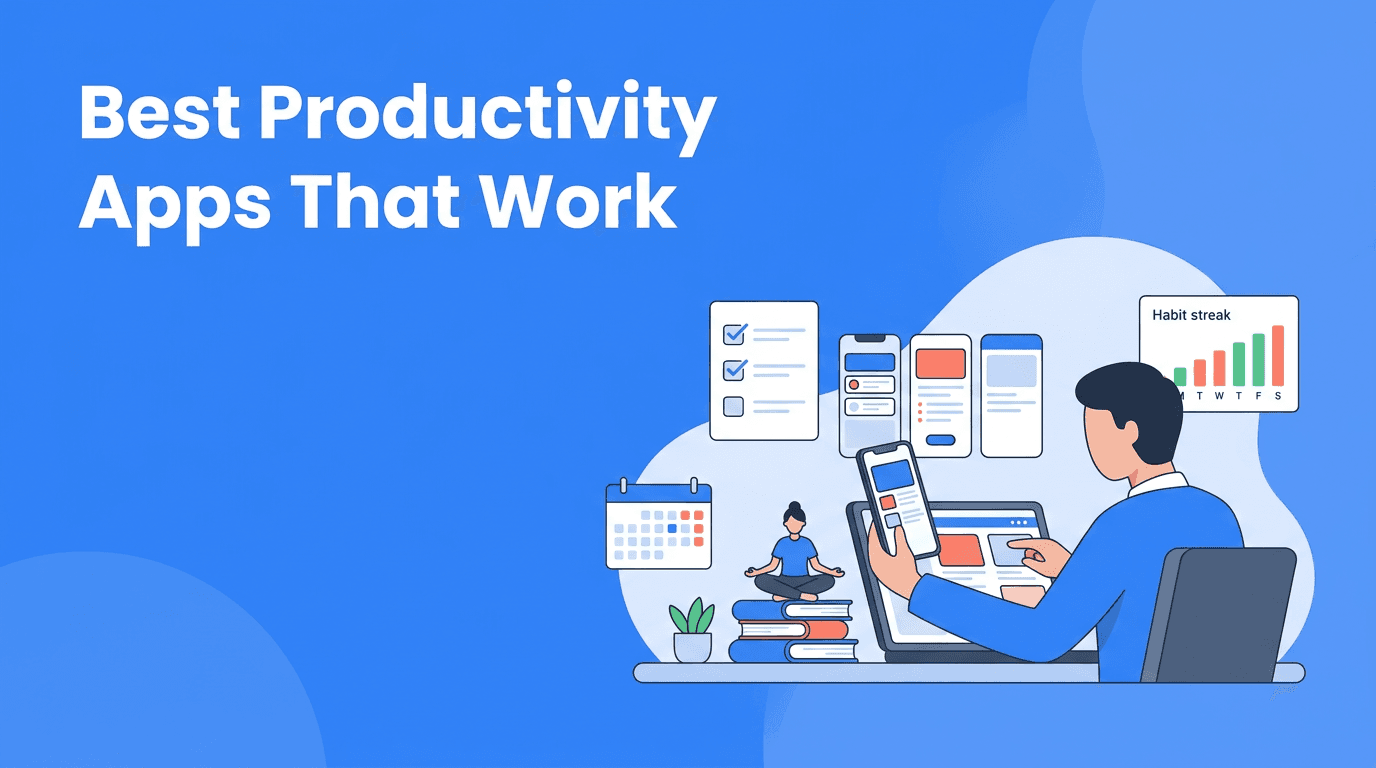
The best plans fail without repetition. Good habit tracker apps make progress visible with streaks, reminders, and simple daily check-ins. Streaks, Habitica, and Loop Habit Tracker are popular examples, but the right choice depends on whether you want gamification, clean tracking, or minimal setup.
3. Recovery and mental clarity
High performance is not only about doing more. It is also about resetting faster. That is where meditation apps like Calm, Headspace, and Insight Timer help. Even five minutes of breathing or a guided session can reduce task-switching fatigue and make focused work easier.
4. Guidance and learning
Modern AI apps and reading apps can close the gap between good intentions and daily action. AI tools can help you reflect, plan, and stay accountable. Reading platforms can turn spare minutes into steady learning. Used well, they support momentum instead of adding noise.
You do not rise to the level of your goals. You fall to the level of your systems.
A practical comparison: all-in-one app versus specialized app stack
There is no single winner for everyone. The best choice depends on how much complexity you can realistically maintain.
- All-in-one approach: Best for people who want fewer logins, fewer notifications, and one daily home base.
- Specialized stack: Best for people with clear preferences who enjoy optimizing each part of their workflow.
- Hybrid setup: Best for most people. Use one main app for daily guidance, then add one or two specialists only where needed.
For example, Haply fits well in a hybrid or all-in-one setup. It is an AI life coaching app on iOS and Android that combines chat-based coaching with practical tools for productivity, wellness, career, learning, finance, creativity, and relationships. Instead of making you manage everything manually, it personalizes the experience through goal-based onboarding, a Today Dashboard, habit streaks, reminders, and mini-tools like a Focus Timer, Task Planner, Meditation/Breathe, Sleep Stories, Budget Tracker, and Idea Board.
How Haply compares with other app categories
Compared with classic productivity apps
Traditional task apps are often stronger for deep project management, but they can feel cold or rigid when you need motivation. Haply adds coaching and context, which can help if your issue is not organization alone, but staying engaged and consistent.
Compared with habit tracker apps
Pure habit tools may offer more advanced habit analytics, but Haply combines habit tracker apps features with coaching, reminders, and a daily dashboard. That makes it useful if you want habit support tied to broader goals rather than isolated streaks.
Compared with meditation apps
Dedicated meditation apps usually have larger audio libraries, but Haply works well if you want mindfulness built into the same app you use for planning and self-improvement. Its Meditation/Breathe and Sleep Stories features support calm without forcing another download.
Compared with AI apps
Many AI apps generate ideas or answer questions, but not all of them coach behavior change. Haply is more specific: it is designed for personalized self-growth across life areas, with structured support instead of one-off prompts.
Best app combinations based on your goal
- If you want fewer apps: Try Haply as your main hub, then add one reading app like Kindle or Blinkist.
- If you want stronger task management: Pair Todoist or TickTick with Haply for coaching and habits.
- If stress is your main blocker: Use Haply or Headspace for recovery, plus a simple task app.
- If you want to learn daily: Combine Haply with reading apps such as Kindle, Libby, or Shortform.
- If you love data and optimization: Keep a specialist planner, one of the stronger habit tracker apps, and one AI coaching tool.
Want one app that supports more than productivity?
Haply helps you plan, build habits, reduce stress, and stay accountable with personalized AI coaching and practical mini-tools. You can try the 7-day free trial and see if an all-in-one approach fits your routine.
Try Haply FreeHow to choose without wasting another weekend testing apps
- Pick one primary outcome for the next 30 days, such as finishing work on time, meditating daily, or reading more.
- Choose one main app that supports that outcome directly.
- Add only one supporting app if there is a clear gap.
- Turn off non-essential notifications in the first hour.
- Review your usage after 7 days: Did the app reduce friction or create more of it?
- If you skipped it for three days, simplify. The best productivity apps are the ones you actually return to.
This is the filter most recommendation lists miss. You are not choosing apps for their feature pages. You are choosing them for your real energy, attention, and schedule.
Final takeaway on the best productivity apps
The best productivity apps are not always the most powerful ones. They are the ones that help you plan clearly, follow through consistently, and recover well enough to do it again tomorrow. For some people, that means a specialized stack. For many, it means a simpler system with coaching, habit support, focus tools, and wellness features in one place.
If that sounds closer to what you need, Haply is worth testing. It covers multiple life areas, keeps daily action visible, and helps turn personal growth into something you can actually practice, not just plan.
Frequently Asked Questions
What are the best productivity apps for personal growth?
The best productivity apps for personal growth combine planning, habit support, and reflection. Tools like Todoist, TickTick, Notion, and Haply work well depending on whether you want task management or broader coaching.
Which habit tracker apps are best for beginners?
Beginner-friendly habit tracker apps include Streaks, Loop Habit Tracker, and Habitica. If you want habits plus coaching and reminders, Haply is another practical option.
Are meditation apps worth using for productivity?
Yes. Meditation apps can improve focus by reducing stress and mental clutter. Even short breathing sessions before work can make deep focus easier.
How do AI apps help with self-improvement?
AI apps can personalize guidance, suggest next steps, and keep you accountable. The most useful ones go beyond answers and help you build better routines over time.
What reading apps are good for learning every day?
Kindle, Libby, Blinkist, and Shortform are strong reading apps for daily learning. The best one depends on whether you prefer full books, library access, or quick summaries.