Coaching Psychology Meets AI: A Smarter Model for Behavior Change
Coaching psychology is evolving through AI tools that make behavior change more structured, measurable, and accessible. Learn how evidence-based coaching principles translate into daily practice.

By Haply Team
Haply Editorial Team
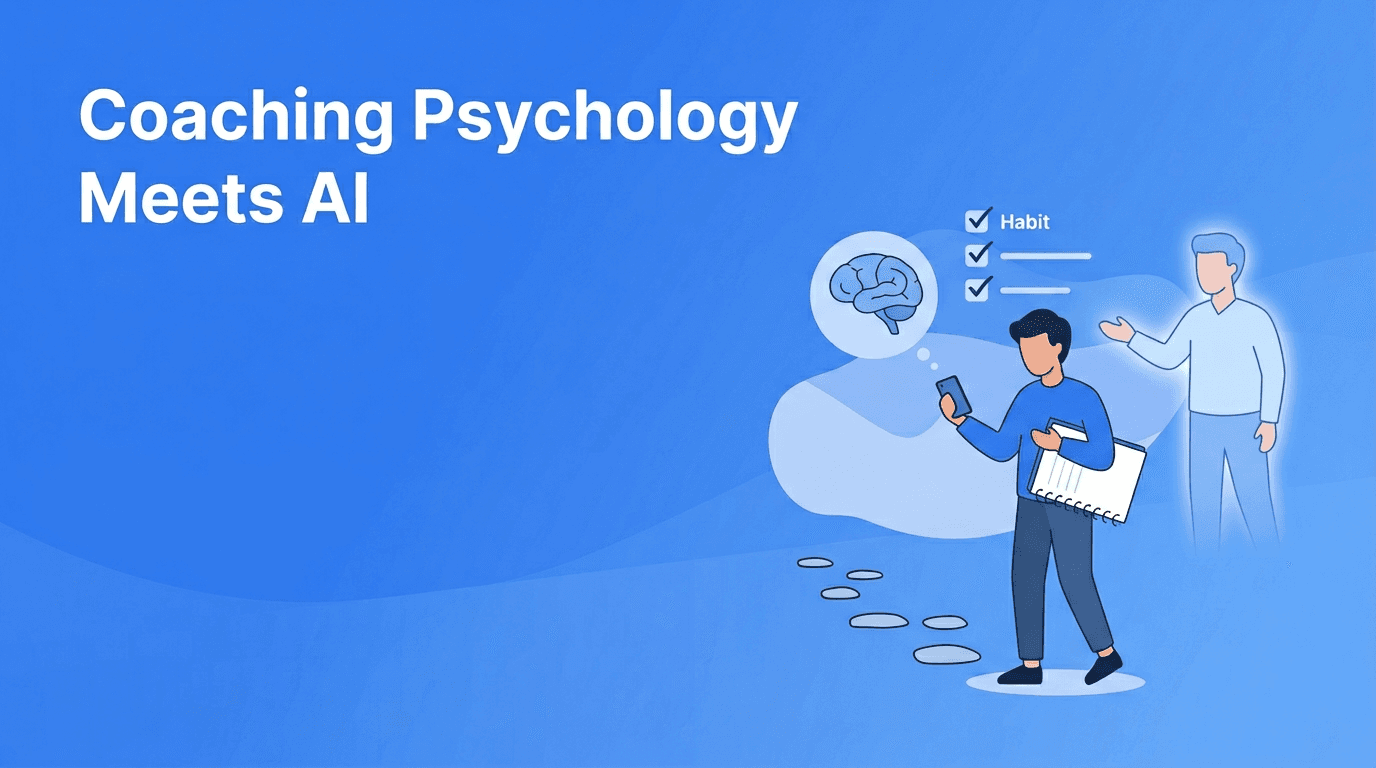
Coaching psychology is no longer limited to traditional one-to-one conversations. As AI becomes part of personal development, the field is gaining a new laboratory: everyday life. Instead of waiting for a weekly session to reflect on goals, people can now apply behavior change principles in the exact moment they struggle, decide, procrastinate, or reset. That shift matters because real growth rarely happens in theory. It happens in context.
Why coaching psychology matters in digital coaching
At its core, coaching psychology studies how people move from intention to action. It draws from positive psychology, motivational science, self-regulation research, and learning theory. The aim is not to diagnose pathology, but to help people build awareness, agency, and sustainable progress. When coaching becomes digital, these principles do not disappear. They become more testable.
- Self-awareness improves when prompts arrive close to the moment of decision.
- Goal clarity increases when abstract ambitions are translated into visible next actions.
- Behavior change becomes easier when reflection is paired with reminders, streaks, and feedback loops.
- Positive psychology interventions, such as noticing strengths or small wins, can be practiced daily instead of occasionally.
From insight to action: the missing link in behavior change
Many people understand what they should do. Far fewer understand why they still do something else. This gap is where evidence-based coaching becomes valuable. Research on implementation intentions, habit formation, and cognitive reframing shows that change improves when people define cues, reduce friction, and examine the thoughts driving avoidance.
What AI adds to the process
AI can support the mechanics of coaching in ways that are difficult to sustain alone. A well-designed system can ask structured questions, detect patterns in your responses, and help you revisit commitments before they disappear into memory. In Haply, for example, users can engage in chat-based coaching, track habits, and use mini-tools like a Focus Timer or Task Planner to turn reflection into behavior. That is important because insight without repetition rarely becomes identity.
"Lasting change is usually less about one breakthrough and more about repeated contact with the right question."
How positive psychology fits into AI coaching
A common misconception is that coaching should focus only on problems. In reality, positive psychology suggests that growth accelerates when people also identify strengths, meaning, optimism, and progress. This is not forced positivity. It is a method for broadening attention so that challenges are addressed without ignoring capability.
- Use strength spotting to identify what already works under pressure.
- Track small wins to reinforce motivation and competence.
- Practice future self reflection to make long-term goals feel more concrete.
- Reframe setbacks as data, not identity statements.
AI coaching can make these interventions more consistent. A person who would never open a textbook on motivation may still respond to a timely prompt asking, "What worked better today than yesterday?" Over time, that question trains attention toward progress, which is one of the most practical insights from coaching psychology.
What makes evidence-based coaching actually evidence-based
The phrase evidence-based coaching is often used loosely. In a stricter sense, it means combining the best available research, professional reasoning, and the user's goals and context. A useful AI coaching system should therefore do more than sound encouraging. It should help users clarify goals, test assumptions, observe behavior, and iterate based on outcomes.
A practical checklist for evaluating AI coaching tools
- Does it help you define specific behaviors, not just vague aspirations?
- Does it support reflection at the right time, not only after the fact?
- Does it include mechanisms for repetition, such as reminders, streaks, or check-ins?
- Does it encourage experimentation instead of perfectionism?
- Does it connect emotional insight with practical action steps?
Try science-backed coaching in daily life
If you want to apply coaching psychology with practical tools, Haply offers AI life coaching, habit tracking, reminders, and focused mini-apps for real-world behavior change.
Try Haply FreeThe future of coaching may be continuous, not occasional
Traditional coaching often depends on scheduled sessions. That model can be powerful, but it also creates a structural problem: life happens between appointments. Technology-powered personal development changes the cadence. Instead of episodic support, users can access continuous reflection, micro-interventions, and immediate planning support throughout the week.
This does not mean human coaches become irrelevant. It means the coaching ecosystem may become layered. Humans may remain especially valuable for nuance, deep emotional complexity, and strategic challenge. AI may become the always-available layer that reinforces learning, captures patterns, and supports everyday behavior change. For analytically-minded users, that hybrid model is compelling because it treats growth as an ongoing system rather than a motivational event.
A simple way to use coaching psychology this week
- Choose one recurring friction point, such as procrastination, sleep inconsistency, or emotional eating.
- Write the exact moment the behavior begins. Be concrete about time, place, and trigger.
- Ask: "What thought usually appears right before this choice?"
- Design one smaller alternative action that takes under two minutes.
- Review the pattern daily for seven days and look for evidence, not excuses.
This is the real promise of coaching psychology in an AI era: not abstract inspiration, but structured self-observation that leads to better decisions. The technology matters because it lowers the activation energy required to notice, reflect, and adjust. The science matters because without it, coaching becomes guesswork.
Frequently Asked Questions
What is coaching psychology?
Coaching psychology is the study and practice of helping people improve performance, wellbeing, and goal progress using psychological principles such as motivation, self-regulation, and strengths-based reflection.
How does AI support behavior change?
AI supports behavior change by providing timely prompts, personalized reflection, reminders, and progress tracking that help people act on intentions in real-life moments.
Is AI coaching evidence-based?
AI coaching can be evidence-based when it uses proven behavior change methods, structured reflection, goal clarity, and feedback loops rather than generic motivation alone.
How is positive psychology used in coaching?
Positive psychology is used in coaching to identify strengths, reinforce progress, build optimism, and help people create meaningful goals without ignoring real challenges.