Implementation Intentions: The Missing Link Between Goals and Daily Productivity
Implementation intentions turn vague goals into clear actions. Learn how this simple productivity system improves habits, scheduling, prioritization, and daily efficiency.

By Haply Team
Haply Editorial Team
Most people do not struggle because they lack ambition. They struggle because their plans stay abstract. Implementation intentions solve that gap by turning a good intention into a specific response you can follow automatically. If you want stronger productivity systems, better habits, smarter scheduling, clearer prioritization, and more daily efficiency, this method is one of the simplest tools to use.
What are implementation intentions?
An implementation intention is an if-then plan. You decide in advance what you will do in a specific situation. For example: "If it is 9:00 AM, then I will start my highest-priority task before checking email." Instead of relying on motivation in the moment, you create a ready-made response.
This approach works because it reduces friction. You are no longer asking, "What should I do now?" You already answered that question earlier, when your mind was calm and strategic.
"You do not rise to the level of your goals. You fall to the level of your systems."
Why this method improves productivity systems
Many productivity systems fail because they stop at task capture or planning. They tell you what matters, but not what happens at the exact moment action should begin. Implementation intentions fill that missing middle step between planning and doing.
- They reduce procrastination by making the first move obvious.
- They support habits because repeated cues trigger repeated actions.
- They improve scheduling by linking tasks to time, place, or context.
- They strengthen prioritization because you define what happens when competing demands appear.
- They increase efficiency by reducing decision-making during the day.
The difference between goals and action rules
A goal says, "I want to finish the report this week." An action rule says, "If I finish lunch on Monday, then I will spend 30 minutes outlining the report." Goals are important, but action rules are what make them real.
How to build implementation intentions that actually work
1. Start with one recurring friction point
Choose a moment where you regularly drift, delay, or get distracted. Maybe your morning disappears into messages. Maybe your workout gets skipped after work. Maybe you avoid hard tasks until the day is almost over. Start there.
2. Use a clear if-then structure
Write plans in a simple sentence: If X happens, then I will do Y. The cue should be observable and specific. The action should be small enough to begin immediately.
- If I open my laptop at 8:30 AM, then I will review my top 3 priorities before any other app.
- If a meeting ends early, then I will use the next 10 minutes to update my task list.
- If I feel the urge to switch tabs during deep work, then I will write the distraction down and return to the task.
- If it is 3:00 PM, then I will handle low-energy admin work instead of forcing creative work.
3. Match the plan to your real life
The best implementation intentions are realistic, not aspirational fantasies. Do not create a rule that depends on perfect energy, unlimited time, or ideal conditions. Build around your actual schedule, common interruptions, and known weak spots.
Using implementation intentions for prioritization and scheduling
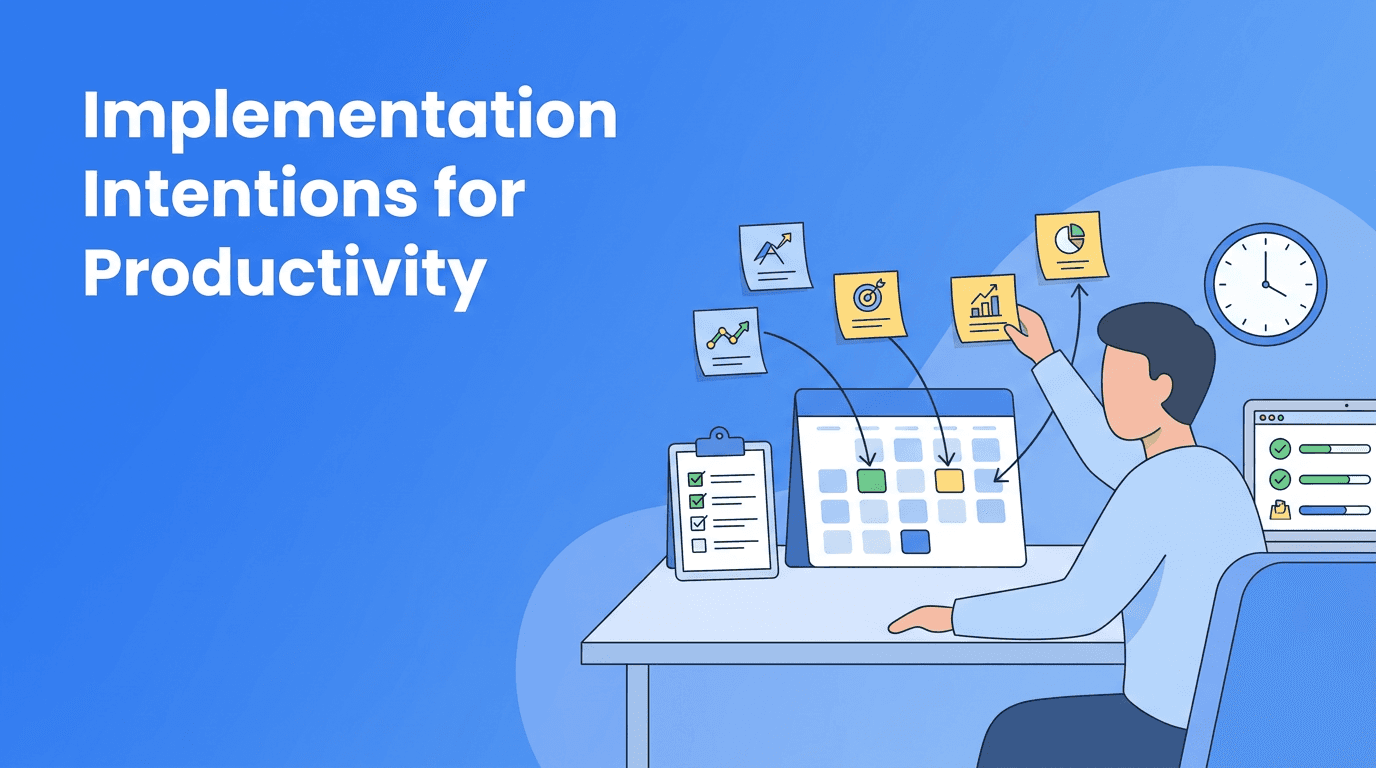
This method becomes even more powerful when paired with weekly planning. During your planning session, do not just list tasks. Assign a trigger for the important ones. That is how scheduling becomes actionable instead of decorative.
- For prioritization, create a rule for your top task: If my work block begins, then I start the most important task first.
- For meetings, decide in advance: If a request can be answered in under two minutes, then I reply. If not, I schedule it.
- For personal habits, link behaviors to stable routines: If I make coffee, then I review today's plan.
- For digital boundaries, set a rule: If I finish a focus session, then I check messages once, not continuously.
Build your system with Haply
Want help turning goals into repeatable actions? Haply is an AI life coaching app for iOS and Android with personalized Productivity coaching, a Task Planner, Focus Timer, daily reminders, and a Today Dashboard that helps you follow through.
Try Haply FreeCommon mistakes that weaken efficiency
If this method feels ineffective, the problem is usually not the concept. It is the way the plan was written. A few small mistakes can quietly reduce efficiency.
- Vague cues: "If I have time" is not a cue. Use a real trigger like time, place, or event.
- Oversized actions: "Then I will finish my presentation" is too big. Start with "Then I will draft three slides."
- Too many new rules at once: Add one or two plans first so they become natural.
- No review loop: If a plan keeps failing, change the cue or shrink the action.
- Ignoring energy patterns: Strong systems respect when you focus best.
A simple weekly reset
At the end of each week, review three questions: Which cue worked? Which action felt too large? Which moment still needs a better rule? This turns implementation intentions into a living system instead of a one-time exercise.
A practical 5-minute setup for beginners
If you want to try this today, keep it simple. Open your notes app or planner and write one if-then plan for each of these categories: start of work, distraction, low-energy period, and end of day. In five minutes, you will have a more reliable decision framework than many complicated productivity setups.
- Start of work: If I sit down at my desk, then I will choose one priority before opening inboxes.
- Distraction: If I want to check social media, then I will wait until my current timer ends.
- Low energy: If I feel mentally tired after lunch, then I will do admin or review tasks.
- End of day: If I finish work, then I will write tomorrow's first task before logging off.
If you want extra accountability, tools can help. In Haply, you can use the Focus Timer, habit tracker, and chat-based Productivity coach to turn these rules into repeatable routines with reminders and streaks.
Frequently Asked Questions
What are implementation intentions in productivity?
Implementation intentions are if-then plans that connect a specific situation to a specific action. They help you act faster and rely less on motivation.
How do implementation intentions help with procrastination?
They reduce hesitation by deciding the response in advance. When the cue appears, you already know what to do next.
Are implementation intentions better than to-do lists?
They serve a different purpose. To-do lists capture tasks, while implementation intentions tell you exactly when and how to start them.
How many implementation intentions should I create at once?
Start with one or two. Once they feel natural, add more for recurring situations like distractions, meetings, or end-of-day planning.