Meeting Recovery Time: The Missing Link Between Work-Life Balance and Burnout Prevention
Meeting recovery time is a practical way to protect work-life balance, reduce burnout risk, and improve energy management for more sustainable productivity.

By Haply Team
Haply Editorial Team
If your day feels full but your real work keeps slipping into the evening, meeting recovery time may be the missing piece. For many professionals, the problem is not just too many meetings. It is the lack of space to mentally reset afterward, which quietly erodes work-life balance, drains energy management, and pushes people closer to burnout.
Why meeting-heavy days feel so exhausting
A meeting does not end when the call ends. Your brain often keeps processing decisions, unresolved questions, social cues, and task shifts. When you jump straight into the next conversation or try to start deep work immediately, you carry mental residue with you. That creates the frustrating feeling of being busy all day without making meaningful progress.
- Cognitive carryover makes it harder to concentrate on the next task
- Emotional load from tense or ambiguous conversations lingers longer than expected
- Context re-entry takes time when you return to writing, analysis, or strategic work
- Energy management becomes reactive instead of intentional when your calendar has no breathing room
"Productivity is not about filling every minute. It is about protecting enough clarity to do what matters well."
What is meeting recovery time?
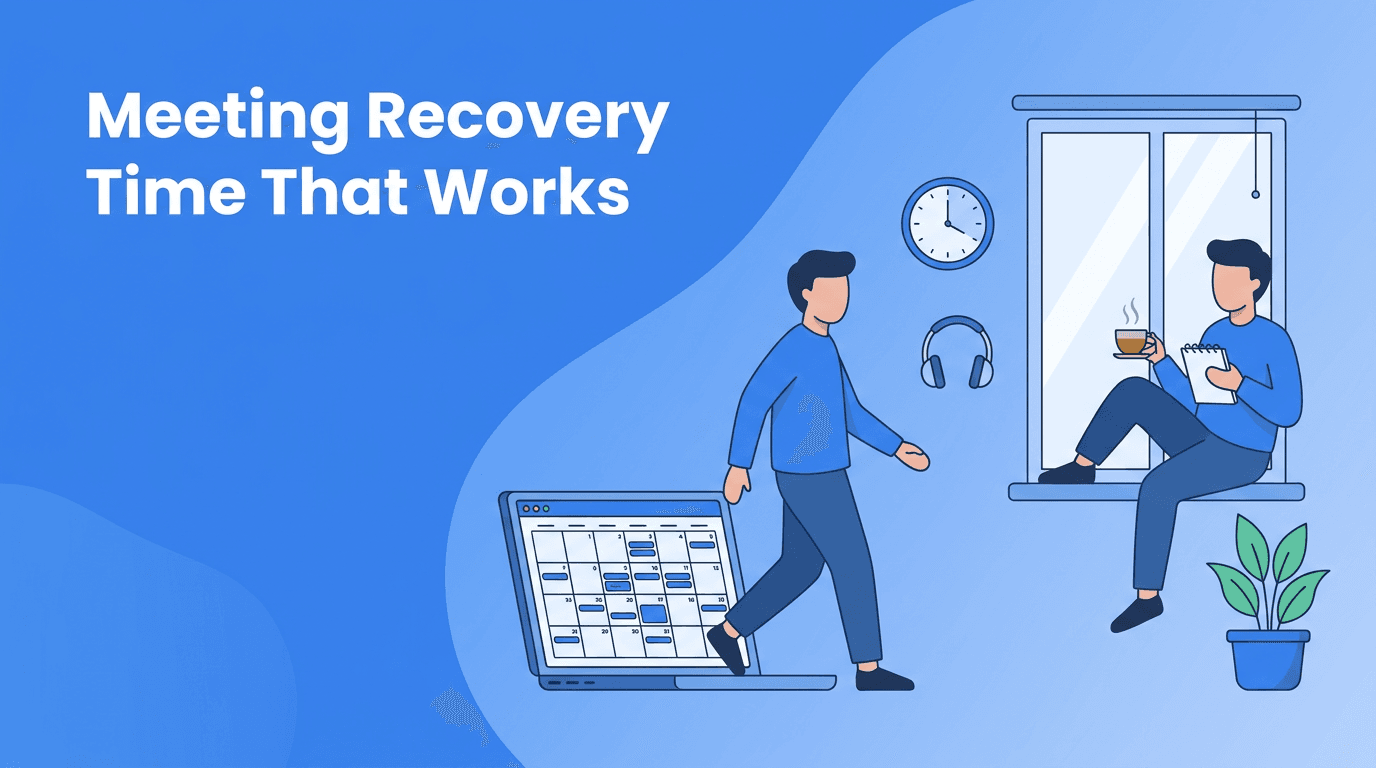
Meeting recovery time is a short buffer between meetings or between a meeting and focused work. It can be as little as 5 to 15 minutes, but it has a specific job: help you close the previous loop before opening the next one. This is not wasted time. It is a small investment that supports sustainable productivity.
What to do during the buffer
- Write down the one decision, one action, and one open question from the meeting
- Stand up, stretch, or take a short walk to reset your nervous system
- Clear your desktop or notes so your next task has a clean starting point
- Choose the first 5-minute action for your next block of work
- If needed, send one follow-up message instead of keeping it in your head
This simple practice improves transition quality. Instead of carrying everything forward, you give your brain a clean handoff. Over time, that can noticeably reduce mental clutter and after-hours catch-up work.
How meeting recovery time supports work-life balance
When professionals talk about work-life balance, they often focus on boundaries after work. That matters, but daytime boundaries matter too. A calendar packed edge to edge leaves no room to think, decide, or decompress, which means important work gets pushed later into personal time.
Adding meeting recovery time helps in three ways. First, it reduces the spillover that turns a normal workday into an evening work session. Second, it improves the quality of your attention, so tasks take less time. Third, it creates a more humane pace, which supports long-term consistency instead of short bursts followed by exhaustion.
The hidden connection to burnout
Burnout rarely comes from one dramatic day. More often, it builds through chronic overload, low control, and inadequate recovery. Back-to-back meetings create all three. You have little agency over your attention, little time to process demands, and almost no recovery built into the day.
- You finish meetings feeling wired and tired
- You need extra time to start even simple tasks
- You postpone focused work until late afternoon or night
- You feel productive on paper but disconnected from meaningful progress
- You become less patient, more forgetful, or more emotionally flat
If these patterns feel familiar, the answer may not be to work harder. It may be to redesign transitions. Meeting recovery time is one of the smallest changes with one of the biggest effects on daily strain.
A practical 3-step system for building buffers
1. Audit your calendar friction
Look at the last 5 workdays and notice where meetings stacked up without space. Identify which meetings consistently leave you drained, confused, or behind schedule. These are your highest-value places to add recovery buffers.
2. Use default gaps, not heroic willpower
Set meetings to end 5 or 10 minutes early by default. If your organization allows it, shorten 30-minute meetings to 25 and 60-minute meetings to 50. A system beats good intentions because it works even on busy days.
3. Match the buffer to the meeting type
- After a routine update, take 5 minutes to capture actions
- After a difficult conversation, take 10 to 15 minutes to regulate and clarify next steps
- Before deep work, use the buffer to define a single outcome for the next hour
- Before switching from work to home, create a brief end-of-day shutdown ritual
Want help protecting your focus every day?
Haply is an AI life coaching app for iOS and Android that helps you build healthier productivity habits with personalized coaching, a Focus Timer, Task Planner, streaks, and daily reminders. If your calendar keeps running your day, Haply can help you create a more supportive rhythm.
Try Haply FreeTools that make the habit easier
You do not need a complicated system. You need visible cues and repeatable steps. Many professionals find it easier to stick with recovery buffers when they use simple tools that support reflection and planning.
- A calendar setting that shortens meetings automatically
- A notes template with Decision, Action, and Question prompts
- A timer for 5-minute reset breaks
- A task list that highlights only the next priority
- A coaching app like Haply for personalized productivity check-ins and daily structure
Inside Haply, the Today Dashboard can help you see your day more clearly, while the Task Planner and Focus Timer make it easier to move from meetings into meaningful work without feeling scattered.
When you cannot control your schedule
Not everyone can freely redesign their calendar. If you work in a meeting-heavy culture, start smaller. Keep one notebook page called Recovery Notes. After each meeting, write three bullets before doing anything else. Even a 90-second reset can improve energy management and reduce the sense of constant mental drag.
- Turn off camera and stand up for one minute between calls when possible
- Avoid checking email during your reset, it steals the buffer
- Batch follow-ups into a planned block instead of sending scattered replies all day
- Protect at least one meeting-free block each week for strategic work
The goal is not a perfect calendar
A healthier workflow is not built by squeezing more into the day. It is built by respecting how attention actually works. Meeting recovery time is a simple but powerful way to support work-life balance, lower burnout risk, and create the kind of sustainable productivity that does not depend on constant overextension.
Start with one buffer tomorrow. Keep it small, repeat it daily, and notice what changes. Often, the most effective productivity fix is not doing more. It is giving your mind enough space to finish one thing before asking it to begin the next.
Frequently Asked Questions
What is meeting recovery time?
Meeting recovery time is a short buffer, usually 5 to 15 minutes, between meetings or before focused work. It helps you process the last conversation, capture actions, and reset your attention.
How does meeting recovery time help prevent burnout?
It lowers the strain of constant task switching and reduces the habit of pushing important work into evenings. That added recovery and control can reduce burnout risk over time.
How many minutes should I leave between meetings?
For most people, 5 to 10 minutes is a strong starting point. Use longer buffers after emotionally intense or decision-heavy meetings.
Can meeting recovery time improve work-life balance?
Yes. When you process meetings during the workday instead of after hours, you reduce spillover into personal time and protect better work-life balance.
What tools can help me build meeting recovery habits?
Calendar defaults, simple notes templates, timers, and coaching tools can all help. Apps like Haply can also support planning, focus sessions, and consistent daily routines.