Mental Contrasting for Self-Improvement: Turn Wishful Thinking Into Real Action
Mental contrasting is a practical self-improvement tool that helps you connect personal growth goals with real obstacles, so you can build momentum, confidence, and better habits.

By Haply Team
Haply Editorial Team
A lot of personal growth advice sounds inspiring in the moment but falls apart in real life. Mental contrasting is different. Instead of only picturing success, you also identify the inner obstacles that could get in your way. That simple shift can strengthen self-awareness, sharpen your mindset, and make self-improvement feel practical instead of vague.
What is mental contrasting?
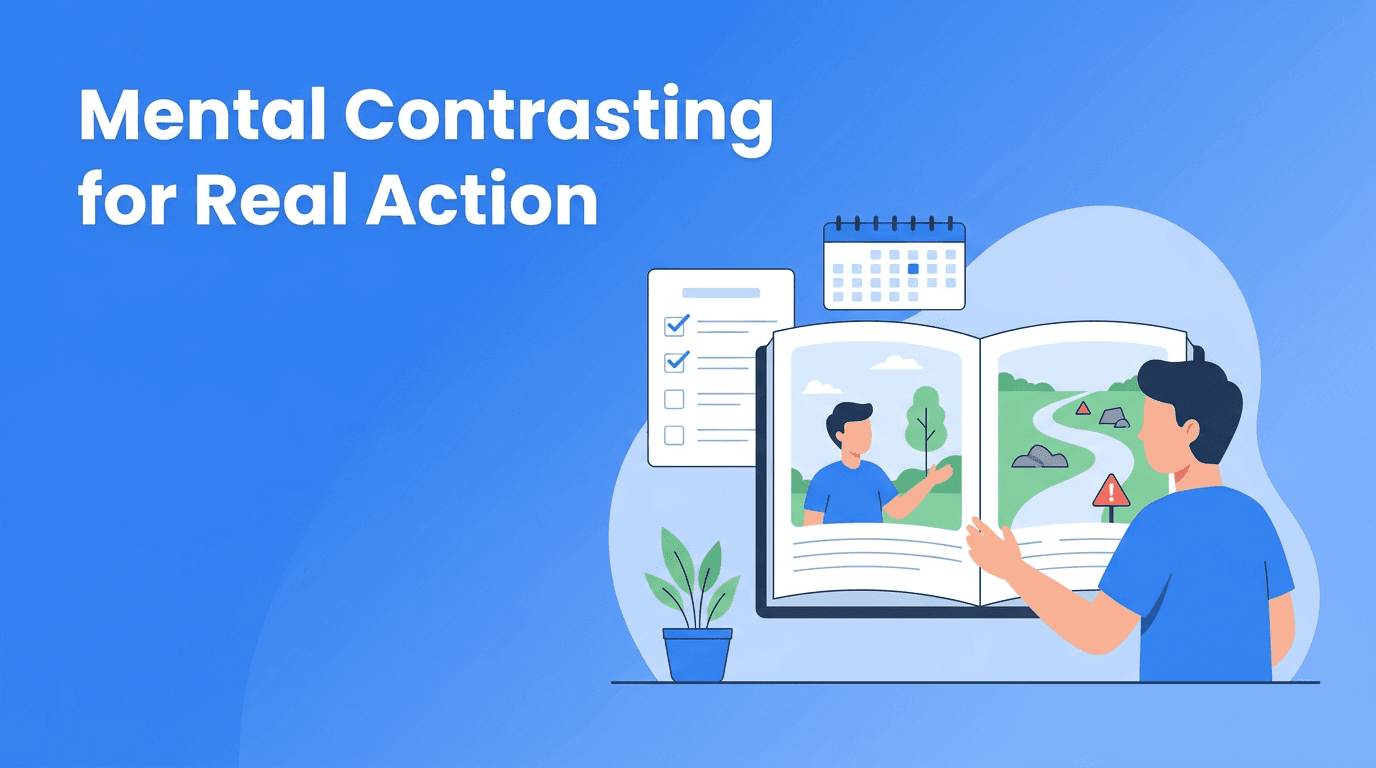
Mental contrasting is a psychology-based exercise where you imagine a meaningful future, then compare it with the current reality standing between you and that future. You do not stop at positive thinking. You ask, "What inside my daily life, behavior, or thinking might block this?" This creates a healthier bridge between motivation and action.
- Picture a goal you genuinely care about
- Name the best outcome if you follow through
- Identify the most likely obstacle within your control
- Choose one small action to handle that obstacle
"Clarity is not just seeing the dream. It is seeing the friction too."
Why mental contrasting works for personal growth
Many people assume motivation comes from confidence alone. But confidence often grows after action, not before it. Mental contrasting helps because it reduces fantasy-based motivation and replaces it with realistic commitment. You are not just saying, "I want to become better." You are saying, "I know what could stop me, and I know what I will do next."
It builds self-awareness fast
If your goal is to read more, exercise consistently, speak up at work, or improve emotional control, the biggest barrier is often not the goal itself. It is the pattern underneath it. Maybe you procrastinate when you feel uncertain. Maybe your habits collapse when your schedule changes. Maybe low confidence makes you delay decisions. This method helps you spot those patterns honestly.
It creates a stronger mindset
A strong mindset is not blind positivity. It is the ability to stay grounded while still believing change is possible. When you use mental contrasting, you train yourself to hold two truths at once: the future can improve, and the present requires effort. That balance is powerful for long-term self-improvement.
How to use mental contrasting in your weekly routine
You can do this in five to ten minutes with a notes app, journal, or guided coaching prompt. It works especially well when you are starting a new habit or resetting after a setback.
- Step 1: Choose one goal for the week, not five. Keep it specific.
- Step 2: Write down the best result you want from that goal.
- Step 3: Ask what internal obstacle is most likely to interfere.
- Step 4: Decide on one response you can use when that obstacle appears.
- Step 5: Review the result at the end of the week and adjust.
A simple example
Let us say your goal is to build a writing habit. The positive future is feeling focused, consistent, and proud of your progress. The obstacle is not "lack of time" but checking your phone every time the work feels uncomfortable. Your action might be: "When I sit down to write, I will put my phone in another room for 25 minutes." That is mental contrasting in action.
Want help turning insight into action?
Haply is an AI life coaching app for iOS and Android that helps you build better habits, strengthen your mindset, and stay consistent with personalized coaching, reminders, and mini-tools like Focus Timer and Task Planner.
Try Haply FreeCommon mistakes that make self-improvement harder
- Setting goals that are too broad. "Be better" is not actionable.
- Blaming only external problems. Real change usually starts with internal patterns.
- Confusing hope with strategy. Inspiration matters, but structure matters more.
- Expecting confidence first. Often, confidence is built by keeping small promises to yourself.
- Ignoring review time. Without reflection, even good habits drift.
Where Haply fits into the process
If you want support beyond a journal page, Haply can make this process easier to repeat. Its chat-based AI coaches can help you clarify goals across productivity, wellness, career, learning, and relationships. You can track your habits, use the Today Dashboard for daily focus, and lean on tools like Meditation/Breathe or the Focus Timer when your obstacle is stress or distraction. For many people, that kind of structure turns good intentions into consistent personal growth.
Try this 7-day mental contrasting challenge
For the next week, pick one area of self-improvement and repeat the same short exercise each morning. Write your desired outcome, your likely obstacle, and your response plan. At night, rate yourself on effort, not perfection. This builds self-awareness and teaches you how your real behavior works under pressure.
- Day 1: Choose one meaningful goal
- Day 2: Notice your most common internal obstacle
- Day 3: Test one replacement behavior
- Day 4: Simplify the habit if resistance is high
- Day 5: Repeat even if motivation drops
- Day 6: Reflect on what improved your confidence
- Day 7: Decide what to keep next week
The point is not to become perfect in seven days. The point is to stop guessing. When you understand the gap between the future you want and the behavior you repeat today, change becomes much more concrete.
Frequently Asked Questions
What is mental contrasting in psychology?
Mental contrasting is a technique where you imagine a desired future and then identify the internal obstacle that could prevent it. It helps turn motivation into specific action.
How does mental contrasting help with self-improvement?
It improves self-awareness, reveals hidden patterns, and helps you create realistic responses to obstacles. That makes goals easier to follow through on.
Can mental contrasting improve confidence?
Yes. It can improve confidence by helping you act on clear plans instead of relying on mood or motivation alone. Repeated follow-through builds trust in yourself.
How often should I practice mental contrasting?
A short daily or weekly practice works well for most people. Consistency matters more than length.