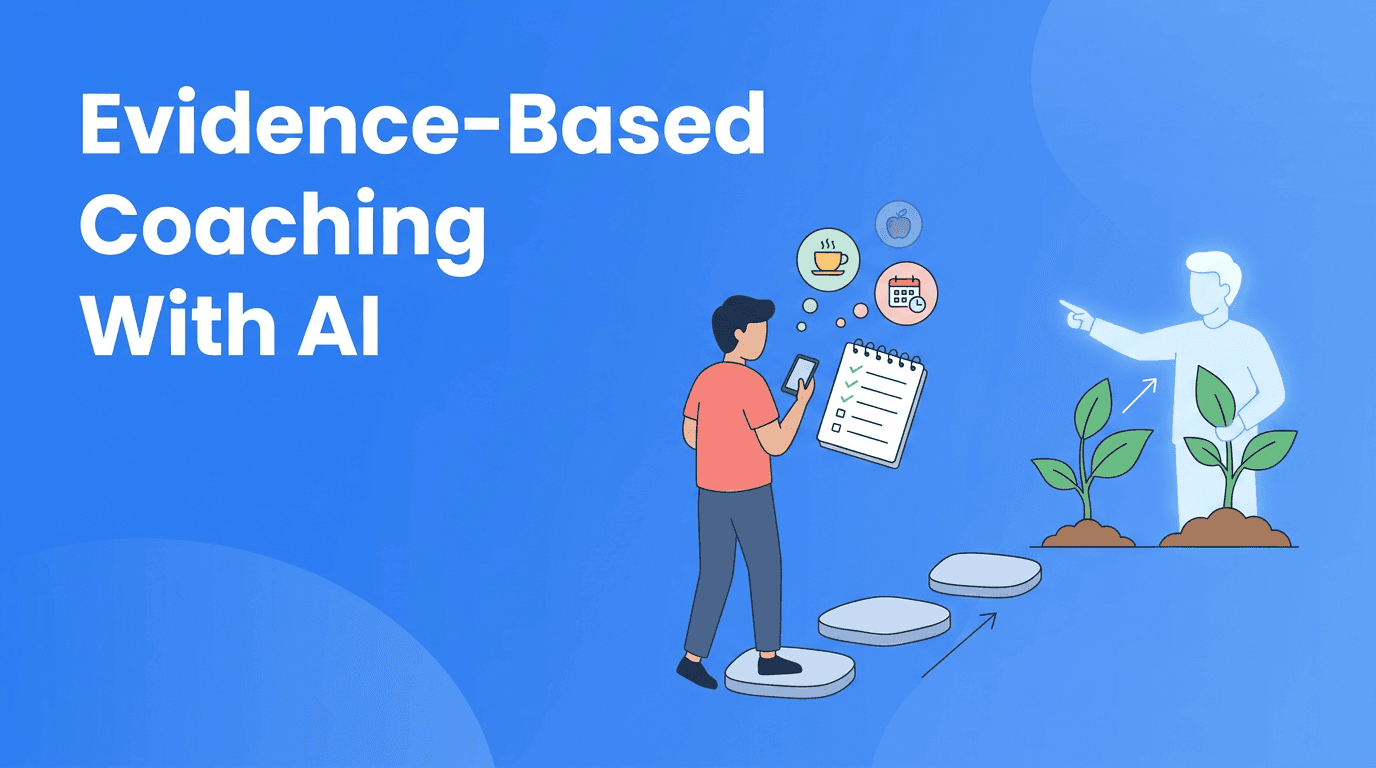
Evidence-Based Coaching: How AI Can Support Real Behavior Change
Evidence-based coaching is becoming more practical with AI. Learn how coaching psychology, positive psychology, and behavior change science can power smarter personal development.

By Haply Team
Haply Editorial Team
Evidence-based coaching sounds clinical, but its promise is simple: help people change in ways that are more reliable, measurable, and psychologically grounded. As AI enters personal development, the interesting question is not whether technology can motivate people for a day. It is whether it can support the deeper mechanisms described by coaching psychology, positive psychology, and behavior change research.
Why evidence-based coaching matters now
For decades, coaching has often been associated with inspiration, charisma, and personal insight. Those elements matter, but analytically-minded people usually want more than encouragement. They want a method. Evidence-based coaching offers that method by drawing from tested ideas in psychology and behavioral science rather than relying only on intuition or motivational style.
This shift matters even more in a digital environment. If an app claims to help users improve focus, resilience, habits, or decision quality, it should be possible to explain how those changes are expected to happen. That is where coaching psychology becomes useful. It gives structure to reflection, goal formation, self-regulation, and feedback loops.
"What gets measured and reflected on consistently is far more likely to improve than what gets admired in theory."
The science behind coaching psychology
Coaching psychology studies how people clarify goals, build self-awareness, strengthen motivation, and translate insight into action. Unlike a vague self-help approach, it asks practical questions: What belief is blocking progress? What environment supports the desired behavior? What type of feedback increases follow-through? What kind of reflection improves learning?
From insight to action
One of the strongest contributions of coaching psychology is the idea that insight alone is insufficient. Many people already know what they "should" do. The challenge is converting knowledge into repeated behavior. That is why behavior change models matter so much in coaching. They focus on cues, routines, rewards, friction, identity, and consistency.
- Self-awareness helps people notice patterns instead of reacting automatically.
- Goal clarity reduces cognitive overload and improves decision quality.
- Implementation planning turns abstract intentions into specific next steps.
- Feedback loops make progress visible, which supports motivation.
- Reflection helps people adjust strategy rather than abandon effort.
Where positive psychology fits
Some people misunderstand positive psychology as forced optimism. In reality, the field studies strengths, meaning, engagement, hope, resilience, and conditions that help people function well. In coaching, that means growth is not only about fixing problems. It is also about identifying what already works and making it more repeatable.
This is especially relevant for AI-supported coaching. A well-designed system should not only point out gaps. It should also surface strengths, reinforce progress, and help users build a realistic sense of capability. That kind of feedback can improve persistence without becoming empty praise.
A more balanced model of progress
- Use strengths-based reflection to identify moments when you performed well.
- Track small wins to support motivation during slow phases of growth.
- Reframe setbacks as data, not identity judgments.
- Pair ambition with self-compassion so learning remains sustainable.
How AI can support behavior change without replacing human judgment
The most useful role for AI is not pretending to be an all-knowing expert. It is providing structure at the exact moments when structure tends to fail in ordinary life: after a long day, during inconsistent routines, in periods of low motivation, or when goals become too vague. In that sense, evidence-based coaching can become more accessible through technology.
An AI system can prompt timely reflection, help break goals into smaller actions, notice recurring obstacles, and encourage regular review. These are not magical abilities. They are scalable versions of core coaching mechanisms. When designed well, they make behavior change easier because they reduce friction between intention and action.
- Daily check-ins support consistency and self-monitoring.
- Prompted reflection helps users identify emotional and behavioral patterns.
- Habit tracking makes progress concrete instead of assumed.
- Personalized coaching paths increase relevance, which improves engagement.
- Mini-tools like timers, planners, breathing exercises, or sleep support can translate reflection into immediate action.
This is where an app like Haply becomes a practical example. As an AI life coaching app on iOS and Android, it combines chat-based coaching with habit tracking, reminders, and interactive tools like a Focus Timer, Task Planner, Meditation/Breathe, Sleep Stories, Budget Tracker, and Idea Board. From a scientific perspective, the value is not just convenience. It is that these features can support the continuity required for evidence-based coaching to work in everyday life.
Want to test science-backed coaching in daily life?
Use Haply to turn reflection into action with personalized AI coaching, habit tracking, and practical mini-tools across productivity, wellness, career, and more.
Try Haply FreeA practical framework for technology-powered personal development
If you want to apply coaching science more rigorously, use this five-part loop. It works whether you use a notebook, a coach, or an app.
- Define one meaningful target behavior. Choose something observable, such as "review priorities for 5 minutes each morning."
- Identify the context. When does the behavior happen? What usually interrupts it?
- Reduce friction. Prepare tools, cues, and the smallest possible version of the action.
- Review weekly. Ask what helped, what blocked progress, and what to modify.
- Reinforce identity. Link the behavior to the person you are becoming, not just the task you completed.
This framework combines elements of coaching psychology, positive psychology, and behavior change science. It is modest by design. Grand transformations usually fail when they ignore context. Small repeatable actions often succeed because they fit real life.
The future of coaching is likely to be hybrid
The future of coaching will probably not be a simple contest between humans and machines. A more plausible outcome is a hybrid model. Human coaches may remain especially valuable for nuance, emotional complexity, ethics, and high-stakes life transitions. AI may become the layer that supports continuity between sessions, increases accessibility, and helps more people practice reflective skills regularly.
That matters because coaching has historically been limited by cost, scheduling, and access. Technology-powered personal development can democratize some of the benefits by making structured reflection available more often and to more people. For many users, the first step into coaching may come through an app, not a formal professional relationship.
"The future of coaching is not just better advice. It is better systems for turning insight into repeated action."
What skeptical readers should watch for
Skepticism is healthy. Not every coaching product is grounded in science, and not every AI experience is genuinely helpful. Look for signs of rigor: clear behavioral goals, structured reflection, progress tracking, personalization, and realistic claims. Be cautious with platforms that promise instant transformation or substitute vague inspiration for process.
- Ask whether the tool supports specific behaviors, not just general motivation.
- Check whether reflection leads to actionable next steps.
- Look for features that improve consistency over time.
- Prefer systems that help you review progress and adapt strategy.
In other words, the best technology for personal growth should make coaching more disciplined, not more theatrical.
Frequently Asked Questions
What is evidence-based coaching?
Evidence-based coaching is a coaching approach informed by research in psychology and behavior change. It uses tested methods to improve self-awareness, goal progress, and sustainable action.
How does coaching psychology help behavior change?
Coaching psychology helps behavior change by improving goal clarity, self-regulation, reflection, and feedback. It focuses on practical mechanisms that turn insight into consistent action.
Is positive psychology actually useful in coaching?
Yes. Positive psychology helps coaching identify strengths, resilience, motivation, and meaning, which can improve persistence and well-being without ignoring real challenges.
Can an AI coaching app support personal development?
Yes, especially for regular check-ins, habit tracking, guided reflection, and structured goal support. It is most useful when it applies evidence-based methods rather than generic motivation.