The Two-Minute Triage Method for Better Productivity and Focus
The two-minute triage method helps you improve productivity, protect focus, and make smarter time management decisions when your task list keeps growing.

By Haply Team
Haply Editorial Team
When your day starts with fifteen tabs, six messages, and a to-do list that keeps expanding, two-minute triage can restore order fast. Instead of trying to do everything, this quick decision method helps you protect productivity, sharpen focus, and improve time management before your attention gets pulled in ten directions.
Why smart people lose time before real work begins
Many professionals and students do not struggle because they are lazy. They struggle because they begin the day in reaction mode. Email, chat, calendar alerts, and mental clutter create the illusion of urgency. The result is low efficiency: you stay busy, but meaningful work barely moves.
The hidden cost is not just lost minutes. It is the mental drag of repeatedly asking, "What should I do next?" Every extra choice chips away at focus. A short triage ritual removes that friction and creates a cleaner path to getting things done.
What is the two-minute triage method?
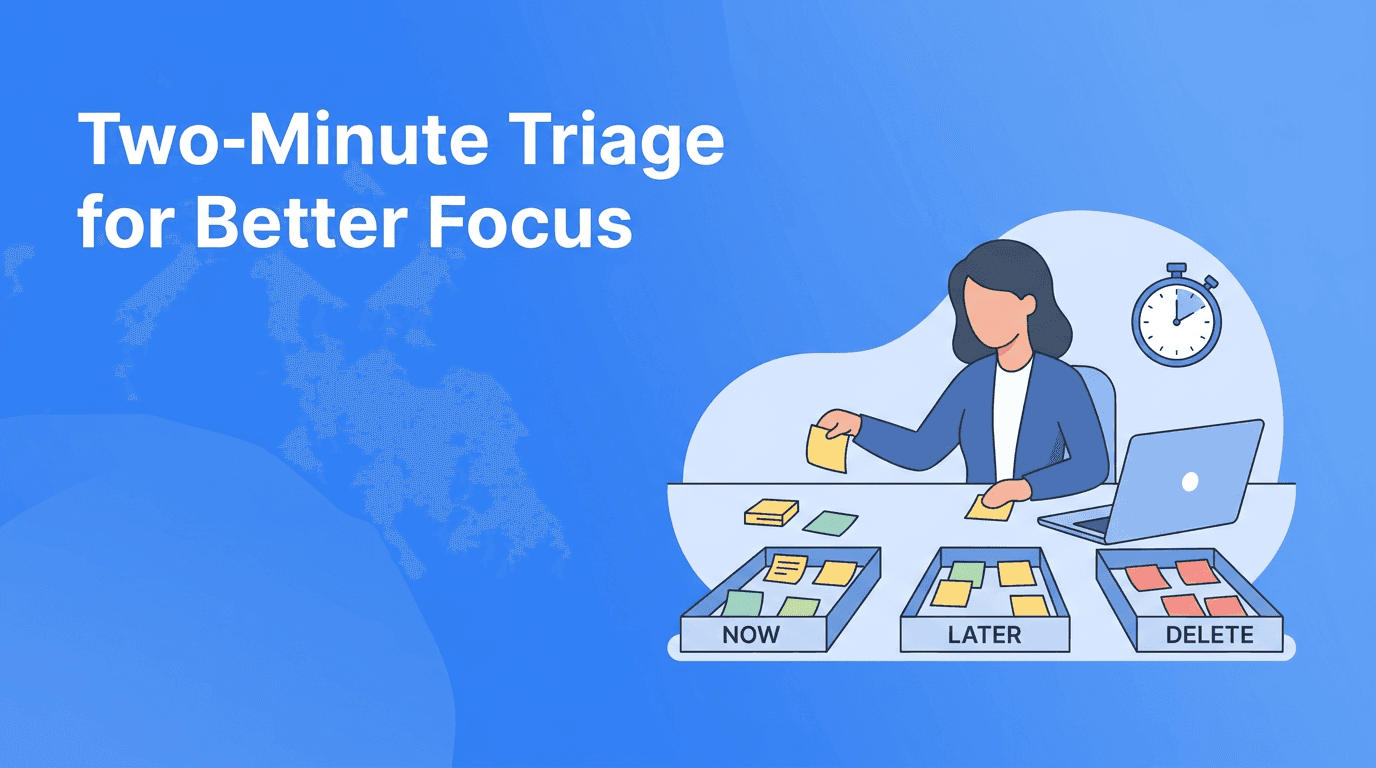
Two-minute triage is a rapid sorting practice you do before starting work. For two minutes, scan everything competing for your attention and place each item into one of three buckets: Now, Later, or Delete. You are not doing the tasks yet. You are making fast decisions so your brain can stop holding open loops.
- Now: Tasks that truly matter today, have a clear next step, and fit your current energy and schedule.
- Later: Important but not for this moment. These need a scheduled review time or calendar slot.
- Delete: Low-value, outdated, optional, or someone-else's-priority tasks that do not deserve your attention.
Why this works better than endless list-making
Traditional task lists often become storage units for anxiety. Triage is different because it forces decisions, not collection. That shift improves efficiency immediately. You stop treating every task as equally important and start managing attention like a limited resource.
"You do not need a longer to-do list. You need a faster way to decide what deserves your mind."
How to use two-minute triage on a busy workday
- Open your notes app, planner, or task manager and gather all loose tasks in one place.
- Set a timer for two minutes. The time limit matters because it keeps you from overthinking.
- Mark no more than three Now tasks. If everything feels urgent, your list is not prioritized.
- Move the rest into Later with a specific review time, such as 1 p.m. or tomorrow morning.
- Delete at least one item every round. This trains stronger judgment and protects focus.
- Begin the first Now task immediately, ideally with a 25-minute work session or a clear stopping point.
This approach is especially useful for knowledge workers whose days are shaped by incoming information. It gives structure without becoming a heavy system. In other words, it supports productivity without adding more admin work.
Where two-minute triage fits into time management
Good time management is not only about calendars and deadlines. It is also about reducing the number of unnecessary decisions you make under pressure. Two-minute triage works best at transition points: the start of the day, after lunch, before a study session, or right after a meeting.
Use it at these four moments
- Morning reset: Decide what matters before messages hijack your plan.
- Midday correction: Re-sort tasks when the morning goes off track.
- Post-meeting clarity: Capture action items and separate real work from noise.
- End-of-day shutdown: Sort tomorrow's tasks so you can start faster the next morning.
These mini check-ins create a simple workflow for getting things done with less stress. Instead of relying on willpower, you rely on a repeatable decision pattern.
Common mistakes that weaken the method
- Turning Now into a list of ten items. If you pick too many, you destroy the method.
- Using Later as a hiding place. If it is worth keeping, assign a date or review trigger.
- Refusing to Delete anything. Real productivity depends on subtraction, not just effort.
- Confusing quick wins with important work. Easy tasks feel productive, but they often steal time from meaningful progress.
- Repeating triage without execution. Sorting is useful only if it leads directly into action.
If you notice these patterns, simplify. The goal is not perfect planning. The goal is better focus and cleaner execution.
Build a daily focus system with Haply
Want help turning quick prioritization into a real habit? Haply is an AI life coaching app for iOS and Android with personalized Productivity coaching, a Task Planner, Focus Timer, habit streaks, and a Today Dashboard that helps you act on your priorities every day.
Try Haply FreeA simple example for students and professionals
Imagine you sit down at 9 a.m. with these tasks: finish a report, answer three emails, prepare for a presentation, update a spreadsheet, and read an article someone sent you. Without a filter, you might start with email because it feels easy. With two-minute triage, you might choose Now for the report and presentation prep, Later for the spreadsheet, and Delete the article if it is not relevant.
That single shift changes the whole day. You spend your best attention on work that actually matters. That is the core of efficiency.
How to make two-minute triage stick
- Attach it to an existing routine, like opening your laptop or pouring your morning coffee.
- Keep one trusted capture system so tasks are easy to review.
- Use a timer every time until the habit feels automatic.
- Track how often triage leads to finishing your top task before noon.
- Review your Delete decisions weekly to strengthen your sense of what is truly worth doing.
If you want more guidance, apps like Haply can make the habit easier to maintain. Its chat-based AI coaches can help you clarify priorities, while tools like the Task Planner and Focus Timer support your daily execution. For people trying to improve productivity without building a complex system from scratch, that kind of support can be useful.
Frequently Asked Questions
What is the two-minute triage method?
It is a quick prioritization routine where you sort tasks into Now, Later, or Delete in about two minutes. It helps reduce overwhelm and improve focus before you start working.
Does two-minute triage help with time management?
Yes. It improves time management by reducing decision fatigue and helping you choose the most important tasks before distractions take over.
How many tasks should go in the Now list?
Usually one to three tasks is enough. Keeping the list short protects focus and makes it easier to finish meaningful work.
Can students use two-minute triage for studying?
Absolutely. Students can use it before study sessions to choose what to work on now, what to schedule later, and what to ignore.
What app can help me build a daily productivity habit?
Haply can help with personalized AI coaching, a Task Planner, Focus Timer, habit tracking, and daily reminders that support consistent productivity habits.